


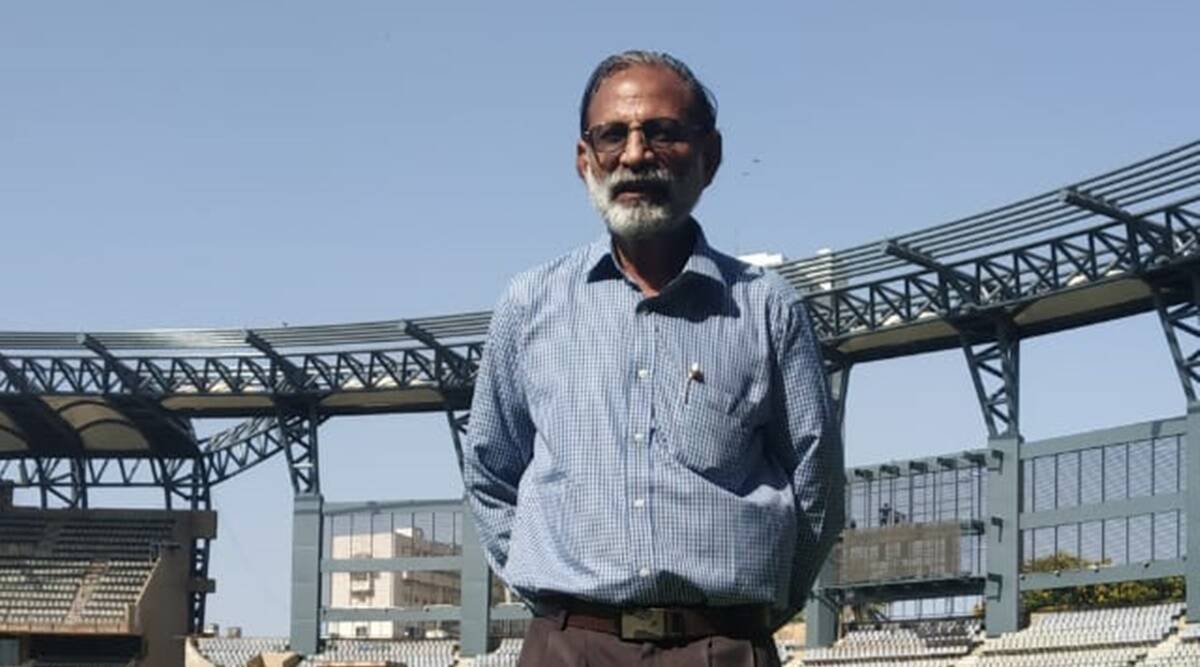
The process had started last week, of dusting off the machinery needed to host a high-profile night game at the Wankhede Stadium. After all, the Indian Premier League (IPL) will return to Indian soil. But it was not the proverbial cobwebs between the gears of a wheel that had to be cleaned.
Kanwal Netar Satyal, a Mumbai Cricket Association (MCA) consultant in charge of all things energy at the site, had to make sure that the four massive floodlights were clear of the eagle nests that had been built in they.
“This was a new problem and we had to send four people with poles on the masts to get them out,” says Satyal. “Their helmets had a pair of eyes drawn on the back. Eagles attack when someone is not looking, so those eyes drawn on the back ensure they won’t attack from behind. “
In a stadium with a capacity for 33,000 fans, Satyal’s role is unknown but of the utmost importance. And it is one that is crucial in Wankhede hosting IPL matches.
“Is there an offer for the stations? Do the elevators work? Is the power supply stable? Are the backup (generators) ready? Is there enough power to hold the cameras?… ”The 62-year-old begins to list his responsibilities.
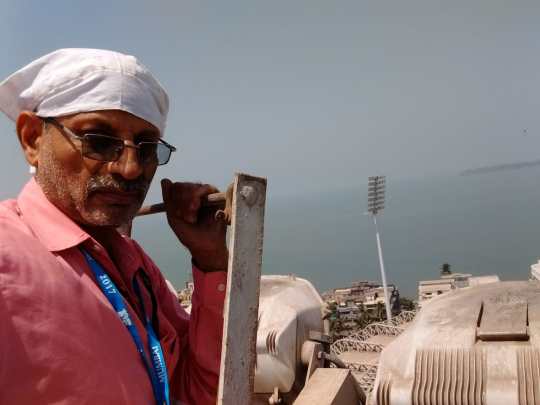 Satyal’s role is crucial in Wankhede which hosts IPL matches.
However, your biggest job is to make sure the bulbs are in working order. It is a task that he keeps close to the chest, after all he was involved in the design phase of all four masts (spotlights). When the stadium was being renovated in 2010, prior to the 2011 World Cup, Satyal was involved in deciding what was needed to illuminate the stadium and the installation process.
“We had to dig 30 meters underground to secure the base of the masts that are 72 meters high. The support was important because the stadium is 200 m from the sea and there are strong winds that will make them swing, ”he says proudly about the gigantic facilities. “Each weighs 45 tons and has 112-118 accessories. And then there are 24 more accessories in other locations – six out of four sets. This helps in general operations to make sure all areas of the floor are illuminated. “
 In a stadium with a capacity for 33,000 fans, Satyal’s role is unknown but of the utmost importance.
That lighting works not only until the game is over. Owners of the Wankhede-based Mumbai Indians franchise, Reliance, often reserve seats for school students on game day. “There was a game a few years ago where some 15,000 students had attended,” Satyal recalls. “The problem with children is that they are slow to come out. And some are mischievous so they will try to hide behind chairs and all. “Around 1 in the morning, the lights were still on and one of the officers noticed it and called me to scold me. ‘Tum murkh ho kya (are you a fool)? The lights are still on. I told him I would call him in the morning. That night, all the students left around 3:30 AM. The lights stayed on until 4 a.m. once everything was clear. Then I sent a message explaining what happened. A few hours later I received a message congratulating me on that decision.
If the lights went out immediately, or as scheduled, ”he explains,“ then it would have been chaos. But situations keep changing. There are many post-match activities, presentations and interviews. So there could be a delay in, say, the folks at Spidercam or the LED advertisers taking down their gear. So we have to wait for everything. “
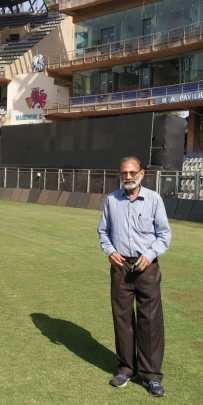
Just as important as the post-match closure is the planning that goes into the beginning of a tournament. Explain that work begins at least 10 days before the opening game and that operations must be ready five days before the game. This includes coordinating with the 30 staff members who report to you on match day. But there have been cases where last minute events were scheduled at the stadium. As in 2014, when it was decided that the swearing-in ceremony of former Maharashtra Chief Minister Devendra Fadnavis would take place at the stadium, in the presence of Prime Minister Narendra Modi. “We were informed only a day and a half before the event,” recalls Satyal.
Throughout his career, Satyal has worked and helped install electrical and lighting systems in cricket and soccer stadiums in Bhutan, Nepal, Oman and Dubai. He has worked in coal mines, naval docks, the maritime liaison in Mumbai and is also a consultant for cricket associations in Punjab and Karnataka. But the native of Ambala is the one who most values his role in the Wankhede.
Despite being so close to the action, he cannot watch the game as he constantly moves from one control room to the other. Nor has he told most of his relatives that he works at Wankhede. “Phir log ticket maangne lagte hai (people start asking for tickets then),” he jokes.
With just a few days before the start of IPL 14, Satyal’s schedule has tightened as she oversees the final preparations. The time spent on this provokes reactions of disbelief.
“People say, ‘arre batti to jalana hai (it’s just turning on the lights),’” he says. “But it’s not that simple. This is a thankless job. “
.

She is a freelance blogger, writer, and speaker, and writes for various entertainment magazines.