


700 Civilian Death in Myanmar protests till now
The largest branch of Myawaddy Bank in Mandalay was attacked Sunday morning and a security guard was injured in the blast, according to local media.
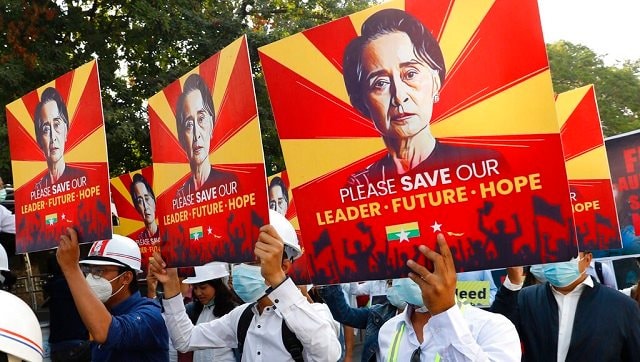
Engineers hold up posters with an image of the deposed Myanmar leader Aung San Suu Kyi as they hold a protest march against the coup in Mandalay. AP
Yangon: A security guard was injured in a bomb blast outside a military-owned bank in Myanmar’s second-largest city on Sunday morning when the civilian death toll from the junta’s brutal crackdown on dissent surpassed all 700 on the weekend.
The country has been in crisis since the army ousted civilian leader Aung San Suu Kyi on February 1.
The largest branch of Myawaddy Bank in Mandalay was attacked Sunday morning and a security guard was injured in the blast, according to local media.
There was a strong security presence in the area after the explosion.
The bank is one of dozens of military-controlled companies that have faced boycott pressure since the coup, with many clients demanding to withdraw their savings.
There has been heavy bloodshed in recent days.
On Saturday, a local watchdog group said security forces shot and killed 82 anti-coup protesters the previous day in Bago city, 65 kilometers (40 miles) northeast of Yangon.
AFP– Verified footage filmed early Friday showed protesters hiding behind sandbag barricades wielding homemade rifles, while explosions were heard in the background.
The United Nations office in Myanmar tweeted on Saturday night that it was following the bloodshed in Bago, where it said medical treatment had been denied to the wounded.
Overall, the Association for the Assistance to Political Prisoners has verified 701 civilian deaths since the coup.
The board has a much smaller number: 248, according to a spokesperson on Friday.
Despite the bloodshed, protesters continued to demonstrate in some parts of the country.
University students and their professors marched through the streets of Mandalay and the city of Meiktila on Sunday morning, according to local media.
Some carried stalks of Eugenia flowers, a symbol of victory.
In Yangon, protesters carried a banner that read: “We will win, we will win.”
Protesters there, as well as in the town of Monywa, began writing political messages on the sheets that included “we must win” and called for UN intervention to prevent further bloodshed.
Across the country, people have been urged to participate in a torchlight protest in their neighborhoods after sunset Sunday night.
The death penalty returns
Unrest also broke out on Saturday in the northwestern city of Tamu, near the Indian border, where protesters fought back when soldiers tried to tear down makeshift barricades erected to block security forces.
Two civilians were killed when soldiers started shooting randomly, a local said, and protesters retaliated by dropping a bomb that exploded and overturned a military truck, killing more than a dozen soldiers.
“Some are in hiding; we are concerned that our people will be hurt in retaliation,” the resident said. AFP.
The growing bloodshed has also angered some of Myanmar’s 20 or so armed ethnic groups, who control swaths of territory mainly in the border regions.
Clashes broke out in northern Shan State on Saturday when the Ta’ang National Liberation Army (TNLA), an ethnic rebel group, mounted a pre-dawn attack on a police station, TNLA Brigadier General said. Tar Bhone Kyaw, who declined to give details.
Local media reported that more than a dozen police officers were killed, while TNLA said the military retaliated with airstrikes against its troops, killing at least one rebel soldier.
State television reported late at night that “armed terrorist groups” attacked the police station with heavy weapons and set it on fire.
Meanwhile, state media reported on Friday that 19 people had been sentenced to death for robbery and murder by a military court, and 17 of them tried in absentia.
They were arrested in North Yangon’s Okkalapa Township, one of six areas in the mall that is currently under martial law, meaning that anyone arrested there is tried by a military court.
Myanmar has had the death penalty for a long time, but has not carried out an execution in more than 30 years, said Phil Robertson, deputy director of Human Rights Watch’s Asia division.
“It indicates that the army is ready to go back to a time when Myanmar executed people,” he said.

She is a freelance blogger, writer, and speaker, and writes for various entertainment magazines.