


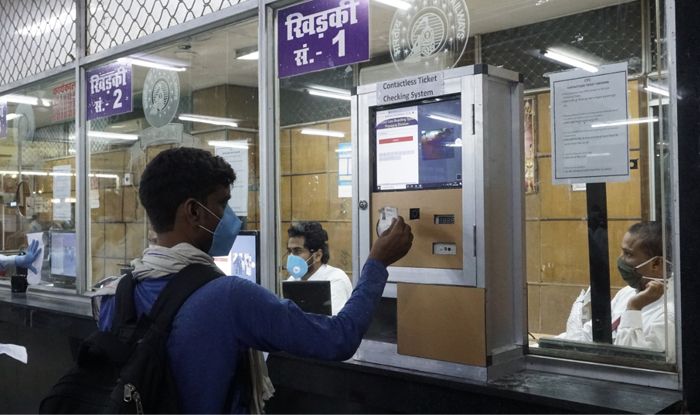
New Delhi: Railroads will move toward contactless ticketings, such as at airports with QR-code-enabled tickets, which will be scanned on portable devices and mobile phones at stations and on trains, a senior official with the national carrier said Thursday.
Railroad Board President VK Yadav said that while 85% of train tickets are being booked online, there will also be a QR code available for those who buy tickets at the counters.
“We have introduced a QR code system, which will be delivered on tickets. If one buys online, the code will be provided on the ticket. Even on window tickets, where a physical ticket is obtained, a text message will be sent to the passenger’s mobile phone, which will have a link, and the QR code will be displayed when the link is touched.
“Then the TTE at the stations or on the trains, either with their handheld equipment or through their mobile phones that will have a QR application, will be able to scan the code and immediately capture the details of the passengers. Then the ticketing system will be completely contactless, ”he said.
Yadav said the railroads do not plan to be completely paperless from now on, but will greatly reduce their use by facilitating the online booking of reserved, unreserved and platform tickets.
He also said that an online recharge service for suburban cards and Kolkata Metro has been enabled. A contactless ticket verification pilot project with airport-like billing was introduced for all passengers entering the station at the Prayagraj junction of the North Central Railway.
A North Central Railway spokesperson explained how the process works at the Prayagraj station.
When a passenger enters the station facilities, the QR code of their ticket is scanned through a mobile application and updated in the software database. The QR code scan time is also updated in the app.
The station has check-in counters to minimize the exposure of control personnel to passengers. The QR code is scanned and thermal inspection of passengers at these counters begins, the official said.
He added that onboard ticket verification staff also collect passenger information simultaneously: all information is provided to their portable machines, including a coach-shaped display showing the number of bunks, unreserved bunks and the number of passes. approach.
“This will help the smooth operation of the line staff and also help transmit the details of the vacant berths to the next location in real-time mode,” the official said.
Yadav said that the IRCTC website will be completely renewed and the processes simplified, personalized and even integrated with hotel and food reservations.
He said the railways have digitized all of their assets for better monitoring. It has also established a geoportal and developed applications for all of its fixed assets, such as tracks, signaling, OHE and other electrical assets, which have been mapped, added to the president of the Railways Board.
The national carrier’s ground plans have been authenticated, digitized and geo-referenced, Yadav said, adding that the railways have introduced digital initiatives in their cargo and train operations.
The cargo operations information system (FOIS), electronic demand registration and electronic payment gateway, integrated coaching management system (ICMS), office control application (COA), crew management system ( CMS), software-assisted train scheduling system (SATSANG)), The Security Information Management System (SIMS), the automatic generation of optimized locomotive links are some of the applications used for a smooth movement of trains of goods said.
Yadav said the railways have signed a memorandum of understanding (MoU) with the Indian Space Research Organization (ISRO) for satellite tracking of trains. This captures real-time data related to the speed and location of trains, provides real-time communication to passengers about arrivals and departures, and analysis to improve operation, he added.
In the first phase, GPS devices were installed in 2,700 electric locomotives and 3,800 functional diesel locomotives. In the second phase, 6,000 additional locomotives will be integrated by December 2021, said the president of the Railways Board.

She is a freelance blogger, writer, and speaker, and writes for various entertainment magazines.