


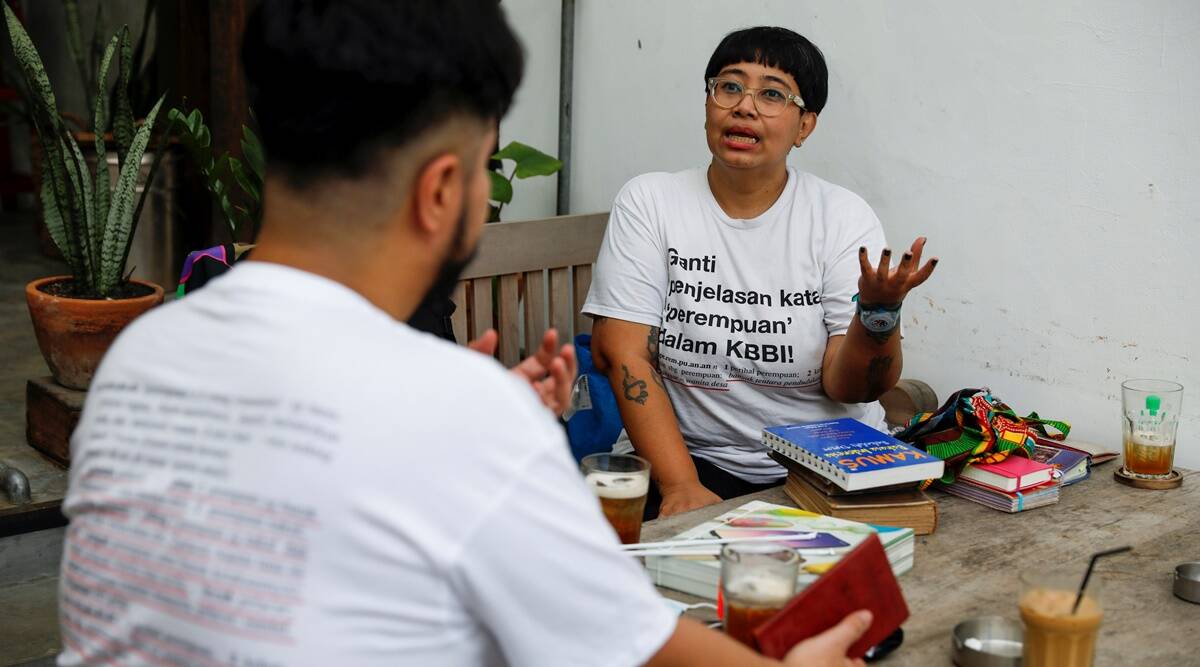
Artist on mission to change Indonesia’s misogynistic dictionary entry for ‘woman’
Hussy, mistress, whore, evil woman – These are just a few of the nine examples of compound words that artist Ika Vantiani was surprised to find in the entry for ‘woman’ or ‘perempuan’ in the official Indonesian dictionary.
All nine were sexualized or derogatory terms. In contrast, in the entry for ‘laki-laki’, one of the words for man, there is only one example, ‘laki-laki jemputan’, which means ‘man chosen as son-in-law’. Another word for man, ‘pria’ also lists a term: ‘pria idaman’ which means ‘heartbreaker’.
Since making this discovery in 2016, Ika has campaigned through his art for change and, as part of that, has assiduously compiled editions of the Kamus Besar Bahasa Indonesia, which is compiled by a government agency and is the standard dictionary used. in schools and by teachers.
“Perempuan jalang, this actually means whore. That’s the only word that keeps appearing in every issue, “he told Reuters.
“The focus is on examples that include words like pelacur or jalang, which means prostitute, a woman who loves to sell herself, unpleasant women, lover.”
Last November, Oxford University Press said it would change the entries for ‘woman’ in its dictionaries to include more positive and active descriptions and Ika expects a similar result.
The campaign has drawn attention to what critics say is a patriarchal culture in the world’s largest Muslim-majority country. Ika has also won the support of Indonesia’s National Commission on Violence against Women, which this year called for a review.
Language, the commission said, “played an important role in building the values of gender equality and the elimination of violence against women.”
Ika and his colleague, Yolando Zelkeos Siahaya, have highlighted the problem in a series of workshops and exhibitions, including one at the Indonesian National Gallery in 2018.
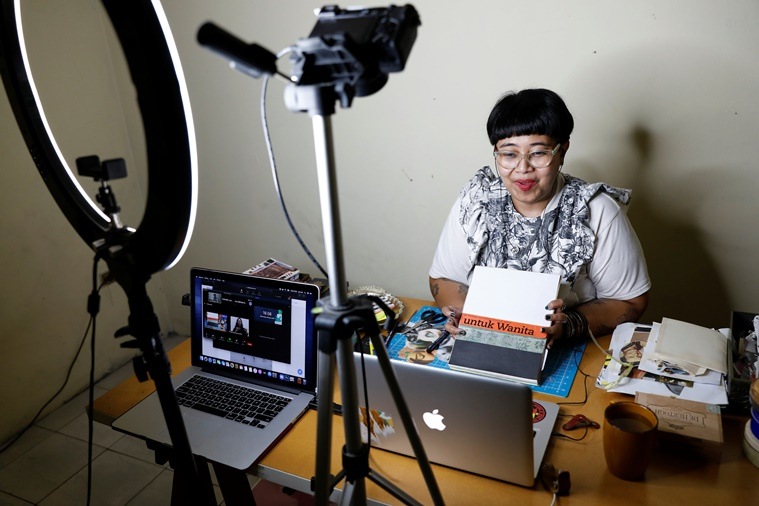 Vantianti displays a handmade diary that reads ‘for women’ on the cover, while advising an online creative diary workshop for women, which has been part of an event to celebrate International Women’s Day, in Jakarta, Indonesia. (Photo: Reuters)
One work featured clear acrylic sheets with the dictionary entry for ‘perempuan’ printed on them so that viewers could imagine being referred to in that way.
“Most people when they see this work of mine, they are surprised,” said Ika. “They say: ‘I never would have thought that this is how the word’ woman ‘is defined in our dictionary.’
Last month her work, which includes t-shirts calling for a change in entrance and worn at a women’s march in 2020, prompted a response from Badan Bahasa, the agency responsible for the dictionary.
The use of the terms, he said, was based on data showing that they were among the most widely used alongside ‘perempuan’.
“As for the social image that arises from the fact that the presentation of information in the dictionary is not ideal, that is another discussion,” he said in a statement posted on his website.
The answer puzzles University of Indonesia linguist Nazarudin, who says 2013 Indonesian language data collected by the University of Leipzig shows that other phrases, such as women’s empowerment or women’s rights, were used. much more frequently.
“The question is, what kind of data did they have?” he asked, “How can you be so negative?”
A Google search shows that there are 98 million entries for ‘hak perempuan’, which means women’s rights, compared to just 481,000 entries for perempuan jalang, the word for ‘whore’.
Badan Bahasa told Reuters that, in addition to the Leipzig data, he was also referring to the Malay Concordance Project, a corpus of classical Malay texts.
Ika says she is hopeful for change.
“I’m not saying I want everything to turn into positive words,” he said, “No. But I want objectivity and real conversations. ”
.

She is a freelance blogger, writer, and speaker, and writes for various entertainment magazines.