


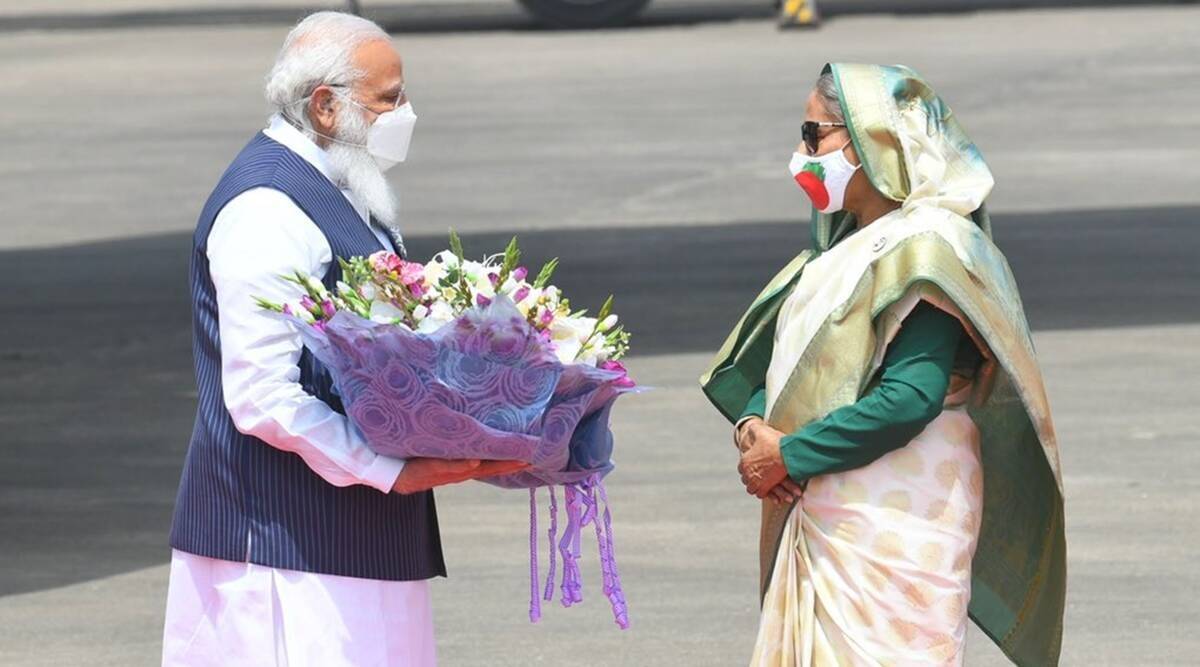
Bangladesh teen held offensive Video mocking Modi
A teenager in Bangladesh has been arrested for making a music video mocking Prime Minister Narendra Modi and his Bangladeshi counterpart Sheikh Hasina, a news agency. AFP reported.
Rabiul Islam, 19, was arrested on Wednesday in a northern city on the basis of a complaint by a pro-government youth leader under the strict Digital Security Law, local police chief Abdullah Al-Mamun was quoted as saying by AFP.
“He made an offensive music video using photos of the prime ministers of Bangladesh and India and posted it on his Facebook timeline,” Al-Mamun said.
Islam faces up to 14 years in prison under the law and is expected to be charged with “defaming and tarnishing the image of the head of government.”
The adolescent’s arrest comes days later Hardline groups launched large-scale protests against Prime Minister Modi’s visit to Bangladesh to commemorate the 50th anniversary of his conquest of nationality. More than a dozen people were killed in the clashes and radical groups also attacked Hindu temples in the country.
Islamist groups accuse Modi of discriminating against Muslim minorities in Hindu-majority India.
What is the Digital Security Act of 2018?
Islam’s arrest was made under the Digital Security Act 2018, which replaced the controversial Information and Communication Technologies (ICT) Act 2006.
The ICT Law gave law enforcement the right to arrest anyone without a warrant for a period of up to 14 years. Between 2012-18, more than a thousand people were arrested under the ICT Act, according to a DW report.
After widespread criticism, the law was replaced by the DSA, which the government said would end arbitrary arrests. But many of the provisions of the ICT Law were reproduced in different forms in the new law.
Hundreds of people have been arrested since 2018 under the Act for alleged crimes that include smearing the image of the prime minister and other political figures.
Section 21 of the DSA authorizes life imprisonment, along with a heavy fine, for engaging in “propaganda” or a “campaign” against the “spirit of the liberation war”, “father of the nation”, the “national anthem “or” national flag “.
Section 25 of the law provides special protection to the state and therefore can be used to prohibit or punish legitimate political expression.
International organizations such as Human Rights Watch and Amnesty International have spoken out against the new digital law, saying it has tightened the government’s control over freedom of expression.
The new law also prohibits effective investigative journalism, said the Bangladesh Editors Council, an association of newspaper publishers.
In March, widespread protests were held across the country over the death of writer Mushtaq Ahmed while in detention, who was arrested under DSA for posting an article and sharing posts on Facebook that were critical of Hasina’s handling of the coronavirus pandemic.

She is a freelance blogger, writer, and speaker, and writes for various entertainment magazines.