


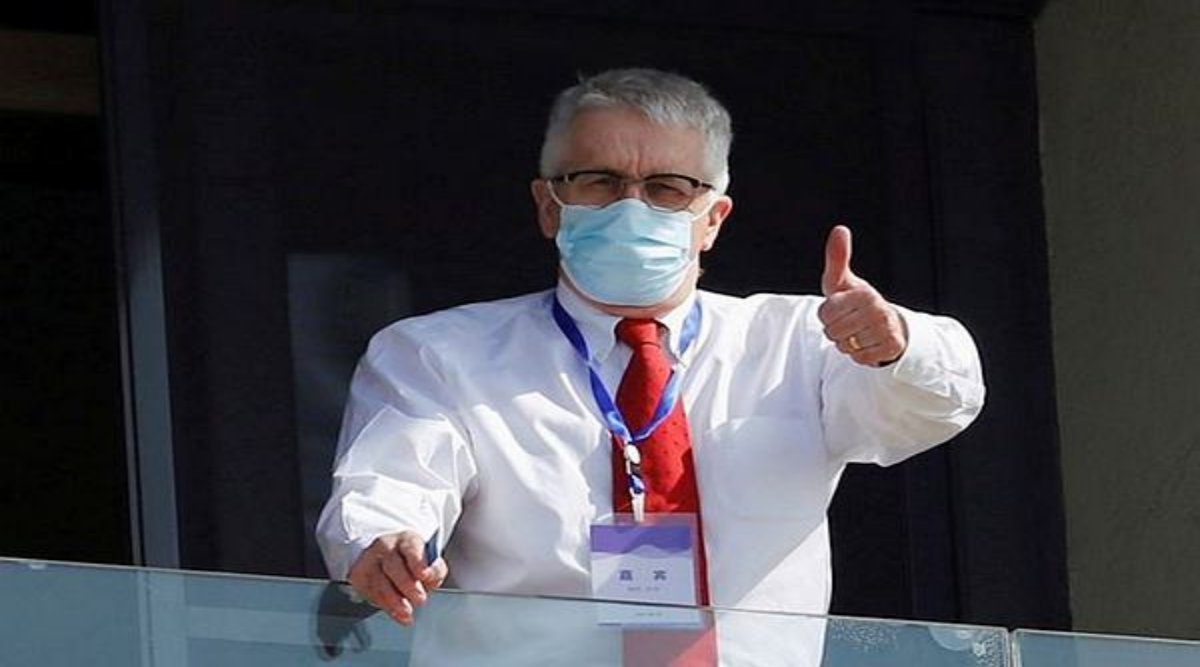
China declined to provide raw data on early COVID-19 cases to a team led by the World Health Organization investigating the origins of the pandemic, one of the team’s researchers said, potentially complicating efforts to understand. how the outbreak started.
The team had requested raw patient data on the 174 COVID-19 cases that China had identified in the initial phase of the outbreak in the Chinese city of Wuhan in December 2019, as well as other cases, but only provided a summary. . said Dominic Dwyer, an Australian infectious disease expert who is a member of the team.
Such raw data is known as “line lists,” he said, and would normally be anonymized but contain details such as what questions were asked of individual patients, their responses and how their responses were analyzed.
“That is standard practice for investigating an outbreak,” he told Reuters on Saturday via video call from Sydney, where he is currently in quarantine.
He said that gaining access to the raw data was especially important as only half of the 174 cases were exposed to the Huanan market, the now-closed wholesale seafood hub in Wuhan where the virus was initially detected. ” ask for that, ”he said.
“Why that doesn’t happen, I can’t comment. Whether political, time consuming or difficult … But if there are others
reasons the data is not available, I don’t know. One could only speculate. “
While the Chinese authorities provided a large amount of material, it said the issue of access to raw patient data would be mentioned in the team’s final report. “The people at WHO certainly felt that they had received much more data than they had received in the previous year. So that in itself is progress. “
A summary of the team’s findings could be published next week, the WHO said on Friday.
The WHO-led investigation was plagued by delays, access concerns and disputes between Beijing and Washington, which accused China of concealing the scope of the initial outbreak and criticized the terms of the visit, under which Chinese experts carried out the first phase of the investigation. .
The team, which arrived in China in January and spent four weeks investigating the origins of the COVID-19 outbreak, limited itself to visits organized by its Chinese hosts and was prevented from contacting community members due to health restrictions. they went into hotel quarantine.
China’s refusal to release raw data on early COVID-19 cases was previously reported by the Wall Street Journal on Friday. The WHO did not respond to a request for comment from Reuters.
China’s Foreign Ministry did not immediately respond to a request for comment, but Beijing has previously defended its transparency in handling the outbreak and its cooperation with the WHO mission.
HARMONIOUS, WITH ARGUMENTS
Dwyer said that the work within the WHO team was harmonious, but there were sometimes “discussions” with their Chinese counterparts about the interpretation and significance of the data, which he described as “natural” in such surveys.
“We could have a talk about the cold chain and they could be more assertive about what the data shows than we could have been, but that’s natural. If there is political pressure to have different opinions, I do not know. There may be, but it’s hard to tell. “
The cold chain refers to the transport and trade of frozen food. Beijing has tried to cast doubt on the notion that the coronavirus originated in China, pointing to imported frozen food as a conduit.
On Tuesday, Peter Ben Embarek, who led the WHO delegation, told a press conference that transmission of the virus through frozen food is a possibility, but pointed to market vendors selling frozen animal products, including animals. wild farm, as a potential avenue warranting further study. .
Embarek also said the team was not further investigating the theory that the virus escaped from a laboratory, which it considered highly unlikely. The previous US administration of President Donald Trump had said it suspected the virus may have escaped from a Wuhan laboratory, which Beijing flatly denies. “It was a unanimous sentiment,” Dwyer said. “It was not a political coup at all.”
.

She is a freelance blogger, writer, and speaker, and writes for various entertainment magazines.