


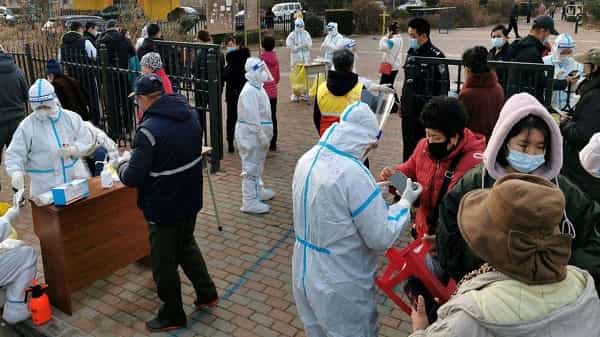
Covid-19 4th Wave in China Hit Badly: Government Issues High Alert.
The situation in China’s capital Beijing has deteriorated as clusters of COVID-19 has emerged.
The country’s financial hub Shanghai has reported 39 more COVID-19-related deaths every day since the outbreak began last month.
According to China’s National Health Commission, the Chinese mainland reported 21,796 cases on Saturday, with 1,566 positive cases and the remainder asymptomatic cases, mainly in Shanghai.
After the city registered 22 new community cases on Saturday, Beijing, China’s top leadership seat, went on high COVID-19 alert, preparing to test specific parts of the populace.
The community was on high alert after ten middle school kids tested positive for COVID-19 on Friday, prompting the school’s suspension of classes for a week.
According to Pang Xinghuo, deputy head of the Beijing Centre for Disease Prevention and Control, unsuspected local infections began approximately a week ago throughout the city. The affected schools, tour groups, and families.
For a week, there were covert transmissions, and the sick people arrived from all walks of life and engaged in various activities,?
The South China Morning Post in Hong Kong reported Pang as stating.
Pang said that mass testing would be done on elderly citizens on tour groups, construction workers, and others who work at the school where the cluster was discovered.
Beijing Communist Party chief Cai Qi, mayor Chen Jining, and other city officials met twice on Friday to plan control operations.
According to the conference, our city [Beijing] had unexpectedly documented some cases, and various transmission chains were involved.
Therefore, there is a significant risk of further undetected transmission. The situation is urgent and bleak, according to the state-run Beijing Daily.
Beijing has taken rapid and severe actions in response to the appearance of new clusters.
According to Global Times, it includes organizing nucleic acid tests in essential groups, implementing partial closed-off management, and suspending classes in the locations and schools that identified the instances.
Given the one-week transmission time, unknown sources of some confirmed cases, and people’s activities in the prior period, Wang Yuedan, a professor at Peking University’s Department of Immunology, said widespread infections are still significant.
However, he informed the newspaper that the epidemic scenario might not be as bad as Shanghai.
He pointed out that the forthcoming May Day holidays, during which millions of Chinese are expected to travel for a one-week vacation, could represent a significant problem in preventing the virus, as many people have made travel plans, thereby increasing the chance of transmission.
The Omicron form of the virus continues to be the epicenter in Shanghai.
Apart from Shanghai, new local COVID-19 cases were reported in 16 additional provincial-level regions on the mainland, including 60 in Jilin, 26 in Heilongjiang, and 22 in Beijing, according to the report.
According to the data, 29,531 persons were being treated for the coronavirus across the country.
Shanghai recorded 23,370 new cases on Saturday, bringing the city’s total to almost 466,000 since March 1.
The city of 26 million people reported 39 COVID-19 deaths on Saturday, increasing the total number of deaths in the city to 87 since it was placed under lockdown at the end of last month due to the outbreak of the Omicron virus.

Eric is a professional news editor, writer, and blogger for the last 10 years. He is working with NewsGater as an off-beat news editor cum writer.