


It only took three months for the rumor that COVID-19 was designed as a biological weapon to spread from the margins of the Chinese internet and take root in the minds of millions of people.
By March 2020, the belief that the virus had been created by humans and possibly armed was widespread, various surveys indicated. The Pew Research Center found, for example, that one in three Americans believed that the new coronavirus was created in a laboratory; one in four thought it was designed intentionally.
This chaos was, at least in part, fabricated.
Powerful forces, from Beijing and Washington to Moscow and Tehran, have struggled to control the narrative about the origin of the virus. Top officials and allied media in all four countries functioned as super-spreaders of disinformation, using their stature to cast doubt and amplify politically expedient conspiracies already in circulation, a nine-month Associated Press investigation into state-sponsored disinformation. made in collaboration with the Atlantic. Found the Council’s Digital Forensic Research Lab. The analysis was based on a review of millions of social media posts and articles on Twitter, Facebook, VK, Weibo, WeChat, YouTube, Telegram, and other platforms.
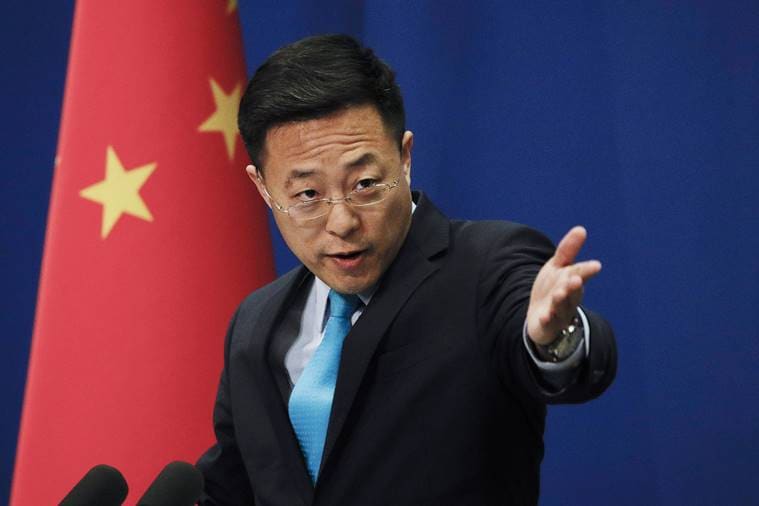 In this Feb. 24, 2020 file photo, Chinese Foreign Ministry spokesman Zhao Lijian speaks during a daily briefing at the Foreign Ministry office in Beijing. (AP Photo / File)
As the pandemic swept the world, it was China, not Russia, that took the lead in spreading foreign disinformation about the origins of COVID-19.
Beijing was reacting to weeks of fierce rhetoric from top US Republicans, including then-President Donald Trump, who was seeking to rename COVID-19 “China’s virus.”
China’s Foreign Ministry says Beijing has worked to promote friendship and serve the deeds, while defending itself against hostile forces seeking to politicize the pandemic.
“All parties must firmly say ‘no’ to the dissemination of disinformation,” the ministry said in a statement to the AP, but added: “In the face of false accusations, it is justified and appropriate to blow up lies and clear up rumors by exposing the facts.”
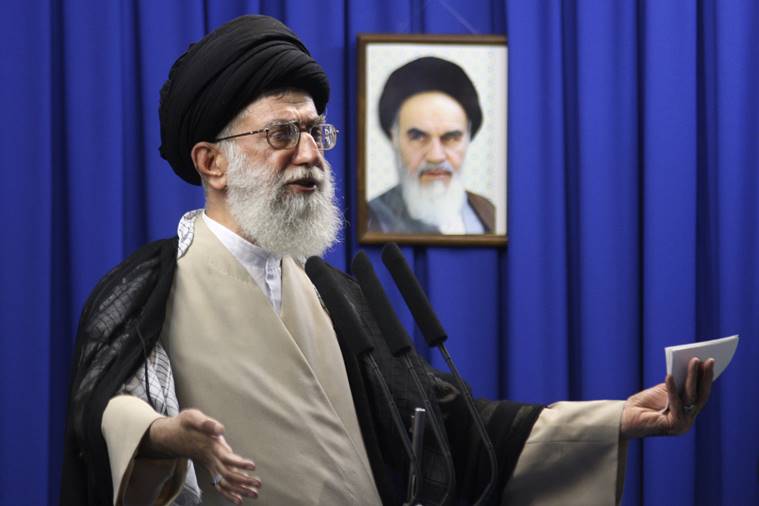 Iran’s Supreme Leader Ayatollah Ali Khamenei was one of the first and most powerful world leaders to suggest that the coronavirus could be a biological weapon created by the United States. (Meisam Hosseini / Hayat News Agency via AP, file)
The day after the World Health Organization designated the COVID-19 outbreak as a pandemic, Zhao Lijian, a spokesperson for the Chinese Ministry of Foreign Affairs, launched a series of late-night tweets that launched what could be the first digital experiment. truly global party with outright disinformation.
Chinese diplomats have recently mobilized on Western social media platforms, more than triple their Twitter accounts and more than double their Facebook accounts since the end of 2019. Both platforms are banned in China.
“When did patient zero start in the US?” Zhao tweeted on March 12. How many people are infected? What are the names of the hospitals? It could be the US military that brought the epidemic to Wuhan. Be transparent! Make your data public! The United States owes us (sic) an explanation! “
What happened next shows the power of China’s global courier machine.
On Twitter alone, Zhao’s aggressive spray of 11 tweets on March 12 and 13 was cited more than 99,000 times over the next six weeks, in at least 54 languages, according to an analysis by DFRLab. The accounts that referenced him had almost 275 million followers on Twitter, a number that almost certainly includes duplicate followers and does not distinguish fake accounts.
Influential conservatives on Twitter, including Donald Trump Jr., criticized Zhao and brought his tweets to their largest audiences.
China’s Global Times and at least 30 Chinese diplomatic accounts, from France to Panama, rushed to support Zhao. Venezuela’s foreign minister and RT’s Caracas correspondent, as well as Saudi accounts close to the kingdom’s royal family, also significantly expanded Zhao’s reach, helping to launch his ideas into Spanish and Arabic.
His accusations received uncritical treatment in the Russian and Iranian state media and were rejected through the QAnon discussion forums. But its largest audience by far is within China itself, even though Twitter is banned there. Popular hashtags about his tweet storm were viewed 314 million times on Chinese social media platform Weibo, which does not distinguish unique views.
Late in the evening on March 13, Zhao posted a message of gratitude on his personal Weibo: “Thank you for your support, let’s work hard for the motherland ?!”
China leaned on Russia’s disinformation strategy and infrastructure, drawing on an established network of Kremlin representatives to seed and spread messages. In January, Russian state media were the first to legitimize the theory that the United States designed the virus as a weapon. Russian politicians soon joined the chorus.
“One amplified the other … How much was controlled by the command, how much was opportunistic, it was difficult to say,” said Janis Sarts, director of the NATO Center of Excellence in Strategic Communications, based in Riga, Latvia.
Iran also intervened. On the same day that Zhao tweeted that the virus could have come from the US Army, Iran’s Supreme Leader Ayatollah Ali Khamenei announced that COVID-19 could be the result of a biological attack. He would later cite that conspiracy to justify the US’s rejection of COVID-19 assistance.
Ten days after Zhao’s first conspiratorial tweets, China’s global state media apparatus was activated.
“Did the United States government intentionally hide the reality of COVID-19 with the flu?” asked a suggestive Mandarin op-ed published by China Radio International on March 22. Why was the US Army Infectious Diseases Medical Research Institute in Ft. Detrick in Maryland, the largest biochemical testing base, shut down in July 2019?
Within days, versions of the article appeared more than 350 times in Chinese state media, primarily in Mandarin, but also worldwide in English, French, Italian, Portuguese, Spanish and Arabic, the AP found.
The Chinese Embassy in France promoted the story on Twitter and Facebook. It was featured on YouTube, Weibo, WeChat, and a host of Chinese video platforms, including Haokan, Xigua, Baijiahao, Bilibili, iQIYI, Kuaishou, and Youku. A seven-second version with driving music appeared on Douyin, the Chinese version of TikTok.
“It is clear that pushing these kinds of conspiracy theories, misinformation, does not usually have negative consequences for them,” said Mareike Ohlberg, principal investigator of the Asia Program of the German Marshall Fund.
In April, Russia and Iran largely abandoned the biological weapons conspiracy in their open messages.
China, however, has continued.
In January, as a World Health Organization team reviewed records in China to try to identify the origins of the virus, MOFA spokesperson Hua Chunying urged the US to “open the biological laboratory in Fort Detrick, to give more transparency to subjects like their More than 200 biological laboratories abroad, invite experts from the WHO to carry out a trace of origin in the United States. “
His comments went viral in China.
China’s Foreign Ministry told the AP that it resolutely opposes spreading conspiracy theories. “We have not done it before and we will not do it in the future,” the ministry said in a statement. “False information is the common enemy of humanity, and China has always opposed the creation and dissemination of false information.”
.

She is a freelance blogger, writer, and speaker, and writes for various entertainment magazines.