


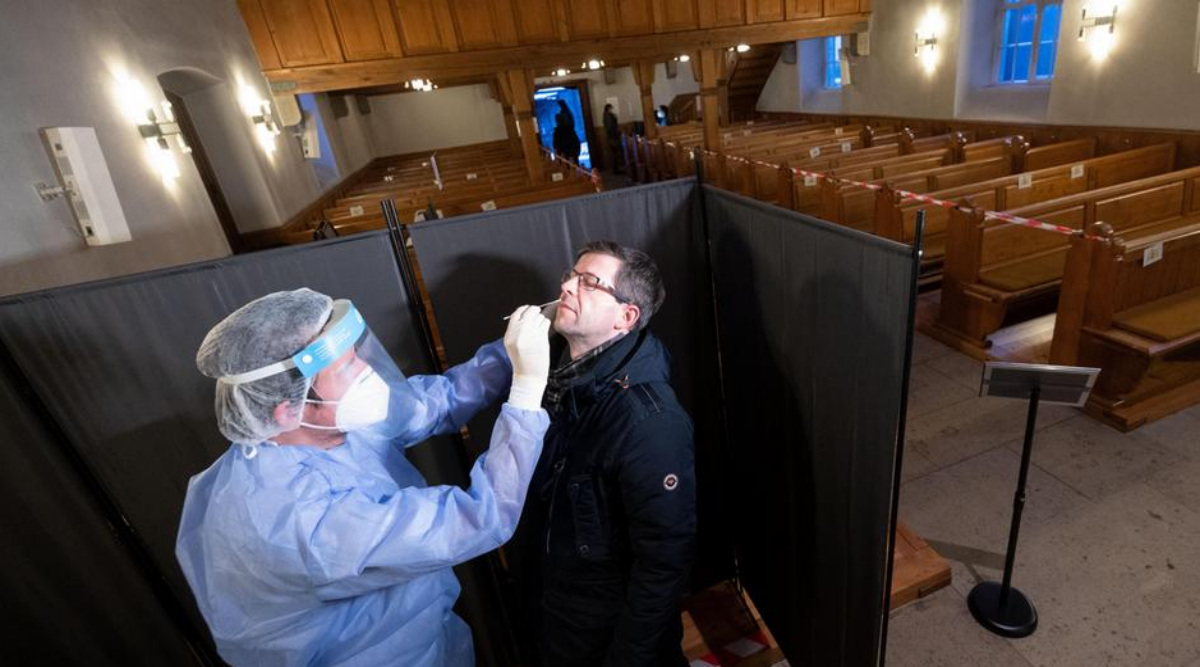
German Health Minister Jens Spahn told reporters in Berlin on Wednesday that the variant of the B117 coronavirus now accounts for 22% of all new infections in the country.
Two weeks ago, the number of cases resulting from the mutation first discovered in the UK was just 6%. Officials fear that despite a reduction in the number of new cases, this could lead to another spike in infections.
What did the Minister of Health say?
Citing data from the Robert Koch Institute for Infectious Diseases, Spahn said:
Germany “must assume” that the variant will soon become “dominant here.”
The percentage of cases resulting from the variant “doubles every week.”
Another 1.5% of cases are caused by the variant first detected in South Africa.
What is Germany doing to counteract the increase in cases?
Spahn said on Tuesday that Germany was planning free antigen tests for all residents starting in March.
Despite the emergence of new variants, Spahn noted that the infection rate had halved within two months of blockage.
The current measures have resulted in the closure of non-essential businesses and private gatherings limited to two households. The measures have substantially reduced the infection rate, but Chancellor Angela Merkel and other government officials have said it is still too early to ease the restrictions.
Germany has introduced strong border restrictions targeting more than a dozen countries and regions where the virus is believed to be widespread. The regions include the neighboring Czech Republic and Austria’s Tyrol.
The British mutation is estimated to be at least 35% more contagious than the new coronavirus.
.

She is a freelance blogger, writer, and speaker, and writes for various entertainment magazines.