


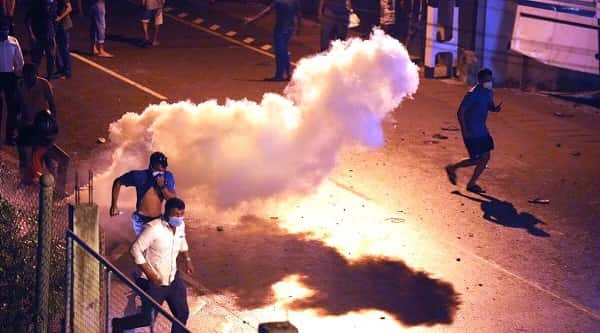
Curfew imposed in Sri Lanka as protests turn violent.
Sri Lanka has been experiencing its worst economic crisis in decades. Protests over the government’s handling of the issue grew violent on Thursday (March 31), prompting the police to impose a nighttime curfew in Colombo’s capital.
Protests outside the mansion of Sri Lankan President Gotabaya Rajapaksa got violent, injuring at least ten persons, including journalists.
According to a Reuters witness, protesters destroyed a wall and hurled stones at police before setting a bus on fire on a road leading to Gotabaya’s apartment. In addition, protesters set fire to a bus and a jeep belonging to the Sri Lankan army.
Because the government does not have enough foreign cash to buy fuel, the island’s 22 million people are subjected to rolling blackouts lasting up to 13 hours every day.
According to a spokesman, as the government seeks a way out of the crisis, the International Monetary Fund (IMF) will begin conversations with Sri Lankan authorities on a prospective loan program in the coming days.
Power Minister Pavithra Wanniarachchi told reporters that the government shuts down street lights to preserve electricity.
A continuing diesel shortage caused further power outages and halted trade on the main stock exchange.
The power outages exacerbate the suffering of Sri Lankans, who are already suffering from food shortages and skyrocketing prices.
Due to a paucity of fuel to generate thermal electricity and water to generate hydropower, Sri Lanka’s Public Utilities Commission has declared that the island nation will experience 12-hour power outages on Friday.
At least 10-hour daily power outages have already occurred in Sri Lanka. In addition, since March 8, the country’s currency has been depreciated by over SLR 90 against the US dollar.
According to the statistics department, retail inflation was 18.7% in March compared to the same month.
In March, food inflation hit 30.2 percent, partly owing to currency depreciation and a restriction on artificial fertilizers that was eventually lifted last year.
According to Dimantha Mathew of First Capital Research, inflation was at its highest level in over a decade. Power Minister Pavithra Wanniarachchi said a diesel supply from India under a $500 million credit line was scheduled on Saturday.
Still, she noted that this would not solve the problem. We will be able to minimize load-shedding hours once that occurs. Still, power cuts will have to continue until we receive rains, which is expected sometime in May,” she told Reuters. “We don’t have any other options.”

Eric is a professional news editor, writer, and blogger for the last 10 years. He is working with NewsGater as an off-beat news editor cum writer.