


From Saddam’s ouster to brutal Islamic State campaign
The Vatican for years has expressed concern about the flight of Christians from the Middle East, expelled by war, poverty, persecution and discrimination. Pope Francis hopes that by visiting Iraq, the first visit by a sitting pontiff, he will send a message of hope and solidarity.
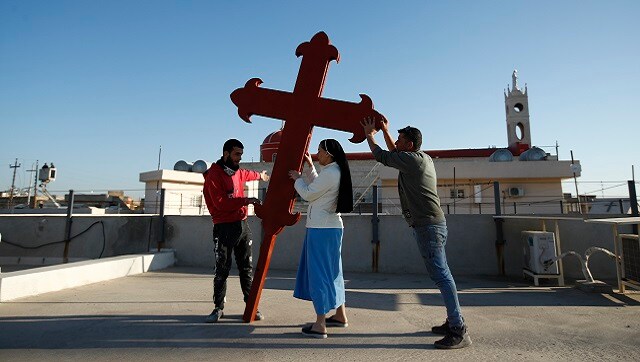
Iraqi Christians place a cross in a church in Qaraqosh, Iraq. (AP Photo / Hadi Mizban)
BAGHDAD – In Iraq, two decades of consecutive conflict have left ancient Christian communities that were once a vibrant and integral part of the landscape scattered and in ruins.
Iraq was estimated to have nearly 1.5 million Christians before the 2003 US-led invasion that toppled dictator Saddam Hussein. They date back to the first centuries of the religion and include Chaldean, Syriac, Assyrian, and Armenian churches.
Now church officials estimate that only a few hundred thousand, or even fewer, remain within Iraq’s borders. The rest are scattered around the world, relocating to remote locations like Australia, Canada, and Sweden, as well as neighboring countries.
Many of those who remain in Iraq feel abandoned, bitter and helpless, some suspicious of neighbors with whom they once shared religious holidays and celebrations, both Muslim and Christian.
The Vatican for years has expressed concern about the flight of Christians from the Middle East, driven out by war, poverty, persecution and discrimination. Pope Francis hopes that by visiting Iraq, the first visit by a sitting pontiff, he will send a message of hope and solidarity.
Here’s a look at the disasters Iraq’s Christians have suffered, from Saddam’s ouster to the brutal campaign by Islamic State militants:

In this November 2016 file photo, Iraqi Christians pray at the Church of the Immaculate Conception, damaged by Islamic State fighters during their occupation of Qaraqosh, east of Mosul, Iraq. (AP Photo / Felipe Dana)
INVASION OF THE UNITED STATES AND RISE OF THE MILITAN
Christians in Iraq enjoyed protection and almost the same rights as Iraq’s Muslim majority under Saddam, but were among the first groups to attack amid the security breach and sectarian bloodbath that prevailed for years after the invasion. led by the United States in 2003 that overthrew him.
The American occupation and the chaotic years that followed ushered in religious militancy, led by the Al Qaeda terrorist network. Murders, kidnappings and bombings became a daily occurrence, sometimes with multiple attacks on the same day.
A Chaldean Catholic archbishop was found dead in 2008 after being abducted by armed men. Churches across the country were repeatedly bombed by Sunni militants, terrorizing the community and causing an exodus that continues to this day.
MASSACRE OF THE CHURCH OF BAGHDAD
On October 31, 2010, Islamic militants seized a Baghdad church during Sunday night mass, killing dozens of people, including two priests, in a terrifying four-hour siege. It was the deadliest assault ever recorded against Christians in Iraq.
The Islamic State of Iraq, an offshoot of al-Qaida, claimed responsibility for the attack on Our Lady of Salvation Catholic Church, where Pope Francis is expected to pray this weekend. The carnage deepened mistrust between the besieged community and its Muslim neighbors and fueled the Christian flight from Iraq.
To this day, the memory of the massacre is etched in the minds of the Christian community in Iraq.

In this November 2016 file photo, Iraqi Christians pray at the Church of the Immaculate Conception, damaged by Islamic State fighters during their occupation of Qaraqosh, east of Mosul, Iraq. (AP Photo / Felipe Dana, file)
JUGGERNAUT OF THE ISLAMIC STATE
In the summer of 2014, fighters from the Islamic State of Iraq and the Levant razed the northern city of Mosul and seized a wide swath of the country, including towns and villages on the Nineveh Plains in northern Iraq.
Thousands of Christians found themselves once again fleeing the militants’ advance, taking refuge in the Kurdish region of northern Iraq or leaving the country. During the following years, the extremists killed thousands of Iraqi civilians of various faiths. They also destroyed buildings and ruined historically and culturally significant structures that they considered contrary to their interpretation of Islam. Militants from the Islamic State group demolished religious and historical sites, including monasteries, mosques, tombs, shrines and churches in Syria and Iraq.
The IS giant and the long war to drive out militants left homes looted and buildings charred or pulverized across the north. Christians from the Nineveh Plains fled the Islamic State attack and many of those who returned dream of resettling abroad.
Subscribe to Moneycontrol Pro at ₹ 499 for the first year. Use code PRO499. Limited time offer. * Terms and conditions apply

She is a freelance blogger, writer, and speaker, and writes for various entertainment magazines.