


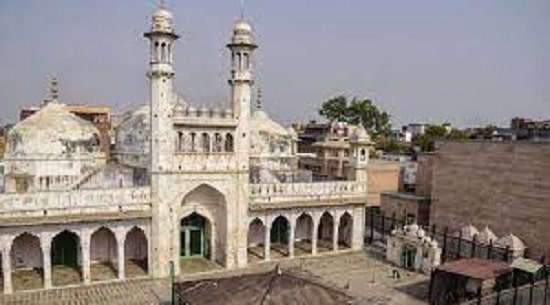
The Supreme Court will hear a plea contesting a court-ordered civil study of Varanasi’s Gyanvapi mosque.
The Gyanvapi survey report will be submitted to the civil court today by the court-appointed committee.
The case will be heard today by a Supreme Court bench consisting of Justices D Y Chandrachud and P S Narasimha.
The court had heard the case of the Gyanvapi mosque controversy on Tuesday and asked the Varanasi District Magistrate to guarantee the safety of the area within the Gyanvapi-Shringar Gauri complex where a ‘Shivling’ is reported to have been discovered in the survey.
READ MORE: Asaduddin Owaisi claims the BJP wants to lead India to the 1990s riots
While hearing the appeal of the Committee of Management Anjuman Intezamia Masjid, which oversees the business of Varanasi’s Gyanvapi mosque, the court ruled that Muslims may continue to give ‘namaz’ there without hindrance.
However, the Supreme Court declined to halt further proceedings before the civil court in Varanasi, hearing the Gyanvapi mosque petition.
The petitioner’s Hindu devotees were served with notifications, and the mosque committee’s case was set for hearing on May 19.
On Wednesday, the Varanasi civil court could not hear the Gyanvapi mosque issue because attorneys in the district went on strike in protest of a government official’s statements.
According to counsel Abhay Yadav, who represents the Muslim side in the case, the Banaras Bar Association and the Central Bar Association, Varanasi, had chosen to boycott work because they were outraged about statements made by a Special Secretary against lawyers. On Wednesday, the court heard two petitions relating to the case.
One was filed by the Hindu side to remove a wall and trash around a ‘Shivling’ that was allegedly discovered during a court-ordered videography survey.
In contrast, the other was filed by District Government Advocate Mahendra Pandey to remove fish from a pond on the property.
According to Yadav, the Muslim side also plans to apply with District Civil Judge Ravi Kumar Diwakar, requesting two days to register an objection to the Hindu side’s plea.
The court likewise turned down this application. He said that the applications would now be considered when the court opens.
The Hindu side’s lawyer, Madan Mohan Yadav, said they had petitioned the Bar Association to enable attorneys to attend the case’s hearing on Wednesday since the whole nation is watching the Gyanvapi Masjid case, but they had received no response.
The mosque is close to the famed Kashi Vishwanath temple, and a group of five Hindu ladies — Rekha Pathak, Manju Vyas, Sita Sahu, Laxmi Devi, and Rakhi Singh — have petitioned the local civil court for permission to worship daily before the statues on the mosque’s exterior walls.
A survey was ordered by a Varanasi civil court to investigate, film, and gather evidence on the claimed presence of Hindu deities within the Gyanvapi mosque, which is situated near the Kashi Vishwanath Temple. Despite mosque leaders’ concerns, the court decided on May 12 to continue the inspection of the Gyanvapi mosque.
The civil court had assigned a court commissioner to perform the site’s survey and videography, which challenged the Allahabad High Court on April 21, which rejected the petition.
The High Court’s April 21 ruling has now been appealed to the Supreme Court. On the petition above, the civil court issued an order for survey and filming of the premises.
Another appeal, filed in 1991 by Vijay Shankar Rastogi, claimed that the whole site belonged to the Kashi Vishwanath Temple and that the Gyanvapi Mosque was simply a component of the Temple.
Rastogi further stated that the Kashi Vishwanath Temple was erected over two thousand years ago and that the Mughal ruler Aurangzeb damaged the temple.
