


Mississippi Rep. Bennie Thompson’s lawsuit traces Trump and Giuliani’s protracted effort to question the election results and seeks unspecified punitive and compensatory damages.
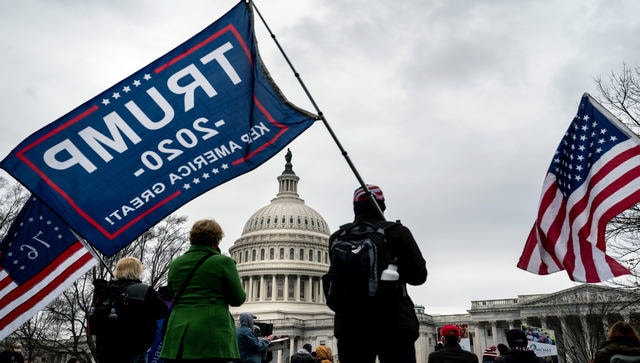
Pesident Donald Trump supporters wave flags as they protest the outcome of the presidential election in front of the Capitol in Washington. Erin Schaff / The New York Times
Washington: A Democratic congressman accused Donald Trump in a federal lawsuit Tuesday of inciting a deadly insurrection on the U.S. Capitol and conspiring with his lawyer and extremist groups to try to prevent the Senate from certifying the results of the presidential elections he lost. before Joe Biden.
The lawsuit by Mississippi Rep. Bennie Thompson, chairman of the House Homeland Security Committee, is part of a wave of litigation expected by the January 6 riot and is believed to be the first filed by a member of Congress. . Seeks unspecified punitive and compensatory damages.
The case also names as defendants the personal lawyer of former Republican President Rudy Giuliani and groups such as the Proud Boys and Oath Keepers, extremist organizations that had members accused by the Justice Department of participating in the siege.
Trump’s lawyers have denied that he incited the riots. A Trump adviser did not immediately comment on the lawsuit Tuesday, and a lawyer for Giuliani did not immediately return an email seeking comment.
The lawsuit, filed in federal court in Washington under a Reconstruction-era law known as the Ku Klux Klan Act, comes three days after Trump was acquitted in a Senate impeachment that focused on accusations. that he incited the riot, in which five people died. . That acquittal is likely to open the door to new legal scrutiny of Trump’s actions before and during the siege.
Even some Republicans who voted in favor of Trump’s acquittal on Saturday recognized that the most appropriate place to deal with Trump was the courts, especially now that he has left the White House and lost certain legal protections that protected him as president.
The lawsuit traces the extensive effort by Trump and Giuliani to question the election results despite the fact that courts across the country and state election officials repeatedly rejected their baseless allegations of fraud. Despite evidence to the contrary, the suit says, the men described the election as stolen as Trump “supported rather than discouraged” threats of violence from his angry supporters in the weeks leading up to the assault on the Capitol.
“The carefully orchestrated series of events that unfolded at the Save America rally and the assault on the Capitol was neither an accident nor a coincidence,” the lawsuit says. “It was the anticipated and predictable culmination of a carefully coordinated campaign to interfere with the legal process required to confirm the count of votes cast in the Electoral College.
Historically, presidents enjoy broad immunity from lawsuits for actions taken in their role as commander-in-chief. But the lawsuit filed Tuesday was filed against Trump in a personal, unofficial capacity and alleges that none of the behaviors in question had to do with his responsibilities as president.
“Inciting a riot, or attempting to interfere with congressional efforts to ratify election results that are praised by the Constitution, could not conceivably be within the scope of the president’s ordinary responsibilities,” said Joseph Sellers, an attorney for Washington, which along with the NAACP, filed the lawsuit on Thompson’s behalf, said in an interview.
“In this sense, because of his conduct, he is like any other private citizen,” Sellers said.
Although the impeachment case focused squarely on the incitement allegations, the lawsuit more broadly accuses Trump of conspiring to disrupt the constitutional activities of Congress – that is, the certification of election results that establish Biden as the winner. legitimate, through a months-long effort to discredit the result and rely on individual states and his own vice president to revoke the contest.
The case against Trump was brought under a provision of the Ku Klux Klan Act of 1871, which was passed in response to KKK violence and prohibits violence or intimidation intended to prevent Congress or other federal officials from carrying out carry out their constitutional duties.
“Fortunately, this has not been used much,” Sellers said. “But what we see here is unprecedented – it really is reminiscent of what led to the enactment of this legislation right after the Civil War.”
The lawsuit cites inflammatory remarks that Trump and Giuliani made in the weeks leading up to the riot and on the day of the riot that lawyers say were designed to mobilize supporters to work to overturn the election results and avoid the certification process. of the Senate. That process was temporarily halted when Trump loyalists stormed the Capitol.
Trump told supporters at a rally that preceded the riot to “fight like hell,” but the former president’s lawyers flatly denied during impeachment that he had incited the riot. They pointed to a comment during his speech in which he told the crowd to behave “peacefully” that day.
Defense attorneys are likely to review those claims in the lawsuit. They can also argue, as was done during the impeachment case, that Trump’s speech was protected by the First Amendment.
Subscribe to Moneycontrol Pro at ₹ 499 for the first year. Use code PRO499. Limited time offer. * Terms and conditions apply

She is a freelance blogger, writer, and speaker, and writes for various entertainment magazines.