


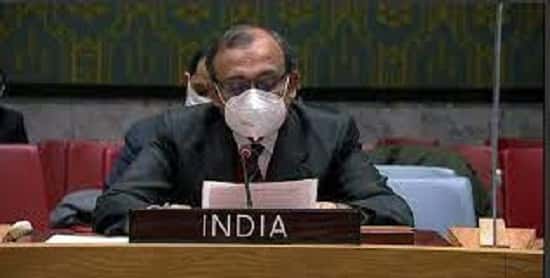
India has called on Monday for “diplomatic dialogue” during a heated discussion regarding
the Ukraine crisis at the United Nations Security Council (UNSC).
Indian ambassador to the United Nations, T S Tirumurti, said, “I reiterate our call for the
peaceful resolution of the situation by sincere and sustained diplomatic efforts to ensure
that concerns of all sides are resolved through constructive dialogue.”
Before the meeting, Russia procedurally requested the vote on whether to hold
the US-initiated meeting.
India, Gabon, and Kenya abstained from the vote to call for the holding of the meeting.
Russia and China opposed the conference.
However, the US attempt to hold the event was successful. It got ten votes, including the
US, France, UK, Brazil, Albania, Ghana, Norway, Mexico, UAE, and Ireland. They needed
Nine votes to allow the meeting to take place. A total of 9 votes was required to hold the
meeting.
Russian officials at the UN expressed gratitude to the countries that did not vote and
abstained from having the conference at the UNSC during his address.
The meeting comes as Russia and the west, under the leadership of US President Donald
The Trump United States has been on the edge of a confrontation over Ukraine.
Russia has deployed troops near their border to Ukraine and the West, fearing a potential
attack, which Moscow has denied.
The Indian representative said that “India’s interest is in finding a solution that can provide
for immediate de-escalation of tensions taking into account the legitimate security interests
of all countries” and “aimed towards securing long term peace and stability in the region
and beyond.”
Russia seeks security assurances by the west, including the promise that Ukraine will not
join in the NATO alliance.
Numerous talks between Russia and the US in the wake of the conflict, including one held
between US Secretary of State Blinken and Russian foreign minister Sergey Lavrov.
The Indian ambassador to India demanded “Quiet and constructive diplomacy” and advised
against “any steps that increase tension” and praised efforts such as those of the Minsk
agreement and the Normandy format.
Minsk Pact was signed on the 14th of January 2014 by Russia, Ukraine, and Organization
for Security and Co-operation in Europe (OSCE) and demands a ceasefire in the eastern
region of Ukraine and gives autonomy to the Russian-speaking regions.
Normandy format, which includes Germany, Russia, Ukraine, and France as it’s essential
elements played a significant role in creating the Minsk agreement.
In the meeting, the representative Tirumurti stressed that the “well-being of Indian
nationals is of priority to us.”
Over twenty thousand Indian students and nationals reside and study across different
regions of Ukraine, including the border regions.
Indian Mission in Kyiv is beginning to collect data about the number of Indian citizens living
in Ukraine.
The envoy further confirmed that New Delhi has been in “touch with all concerned parties.”
January was a month that saw US Secretary of State Wendy Sherman calling Indian foreign
secretary Harsh Shringla for a briefing on the matter.
Three Indo-Russian talks took place during that same month.
The talks include the Deputy Minister of Russia Sergei Ryabkov meeting the Indian envoy to Russia Pavan Kapoor and the Deputy of Russia’s FM Sergey Vershinin calling Indian envoy Kapoor and Vershinin’s Delhi visit to discuss discussions in the presence of Secretary West Reenat Sandhu. Russia was elected head of the UNSC in February.
