


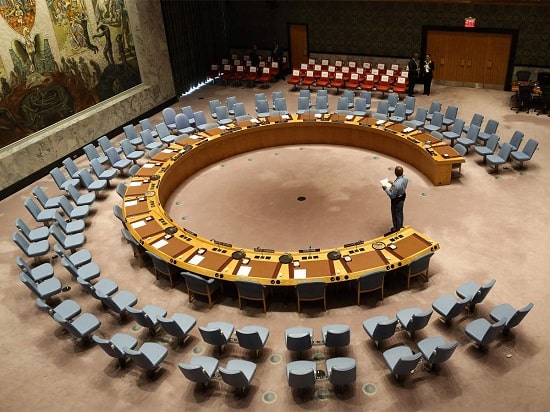
President Ram Nath Kovind has advocated for urgent reform of global institutions centred on the United Nations Security Council to reflect current global realities.
Kovind, the first Indian Head of State to visit this Caribbean island nation, told a special session of the House Assembly of Saint Vincent and the Grenadines on Thursday that multilateralism is more relevant in today’s interconnected and interdependent world than it has ever been in our shared history.
“India and Saint Vincent and the Grenadines– Towards an Inclusive World Order” was the theme of the sitting legislature.
All nation-states should employ multilateralism as a tool to create robust, sustainable, balanced, and inclusive growth. Institutions, he argued, must be modified for multilateralism to remain relevant and practical.
READ MORE: Assam Citizens’ Register NRC Coordinator Files Case Against Former Official
Following the two world wars, the arose structures and organisations concentrated on one fundamental issue: avoiding another global war.
To address today’s complicated difficulties, he continued, the new international order he wants to create must be inclusive, allowing each country to voice its rightful interests.
He said that India’s goal in pushing for a more inclusive international order is to support a universal, rules-based, open, transparent, predictable, non-discriminatory, and equitable multilateral system.
“Reform of global institutions, particularly the UN Security Council, is therefore urgently required to reflect modern global realities. On this subject, he said that “India and St. Vincent and the Grenadines have a shared interest, attitude, and understanding, he remarked.
The UNSC currently has five permanent members and ten non-permanent members chosen for two-year terms by the United Nations General Assembly.
Russia, the United Kingdom, China, France, and the United States are the five permanent members, and they have veto power over any substantive resolution.
In September, the G4 nations of India, Brazil, Germany, and Japan emphasized the need to restructure the Security Council to make it more legitimate, effective, and reflective of the modern world, including emerging countries and significant contributors.
India joined the UNSC as a non-permanent member for a two-year term in January 2021. The country has been at the forefront of years of efforts to reform the powerful 15-nation UN organ, claiming that it rightfully deserves a permanent seat on the Council, which in its current form does not reflect the geopolitical realities of the twenty-first century.
