



ISRO and NASA join hands for NISAR Satellite to track disasters
Seven years since it was first conceived, a car-sized Earth observation satellite is being developed in a joint effort by the National Aeronautics and Space Administration (NASA) and the Indian Space Research Organization. (ISRO). NISAR, (NASA-ISRO Synthetic Aperture Radar), the satellite is scheduled to launch on a three- to the five-year mission, either in late 2022 or early 2023. Head of ISRO saying The satellite will be launched aboard a GSLV Mark-II rocket from the Satish Dhawan Space Center (SHAR), Sriharikota, and placed in a near-polar orbit.
Illustration of the NISAR satellite co-developed by ISRO and NASA. Image credit: NASA.
The Mark-II geosynchronous satellite launch vehicle (GSLV Mk II) is the largest ISRO launch vehicle in use today. It is a three-stage vehicle with four liquid belts. First launched in 2014, the GSLV MK II is a fourth-generation launch vehicle.
About the satellite
“NISAR is an all-weather satellite that will give us an unprecedented ability to observe how the Earth’s surface is changing,” saying Paul Rosen, a NISAR project scientist at NASA’s Jet Propulsion Laboratory (JPL).
NISAR is an Earth observation satellite that will help us understand the causes and consequences of changes taking place on the ground, using advanced radar imagery. It was born from the ‘Decadal Survey’ of the National Academy of Sciences of 2007, which spoke about the importance of monitoring the alterations of ecosystems, the deformation of the earth’s crust, and cryospheric sciences. The 2018 survey further confirmed the need for this type of satellite tracking. With both agencies interested in similar areas, ISRO and NASA teamed up to make this satellite possible. They signed the contract on September 30, 2014.
The duration of the mission of the satellites for both space agencies is different because they have different scientific objectives with the radar bands. According to a NASA statement US space agency requires a “minimum of three years with L-band radar,” while ISRO will use S-band radar to study parts of India and the Southern Ocean for five years.
Mission objectives
The main objectives of NISAR are to double – measure and track changes in the ecosystem and land use, as well as the melting of ice. Measurements are used to aid in forecasts and evaluations.
India has specific issues that it will monitor with NISAR, such as agricultural biomass in the country, disaster management, studying snow and glaciers in the Himalayas, as well as the coastal areas of India and near-shore oceans.
Some other uses for this satellite include monitoring natural crises such as earthquakes, tsunamis, landslides, volcanic eruptions, and groundwater supplies; observe changes in the distribution of vegetation, cropland, and hazard sites.
Using onboard instruments, NISAR will be able to detect signals that indicate when too much groundwater has been pumped or the movement of magma below the surface before a volcanic eruption. You can also provide time slots for these events.
Bands and radar
NISAR will be the first satellite to use two different radar frequencies: L-band and S-band.
ISRO will work on the S-band radar, the spacecraft bus, the launch vehicle (GSLV Mk II) and will also launch the satellite. NASA, on the other hand, will provide the L-band radar, the communication subsystem for science data, GPS receivers, a solid-state recorder, and a payload data subsystem.
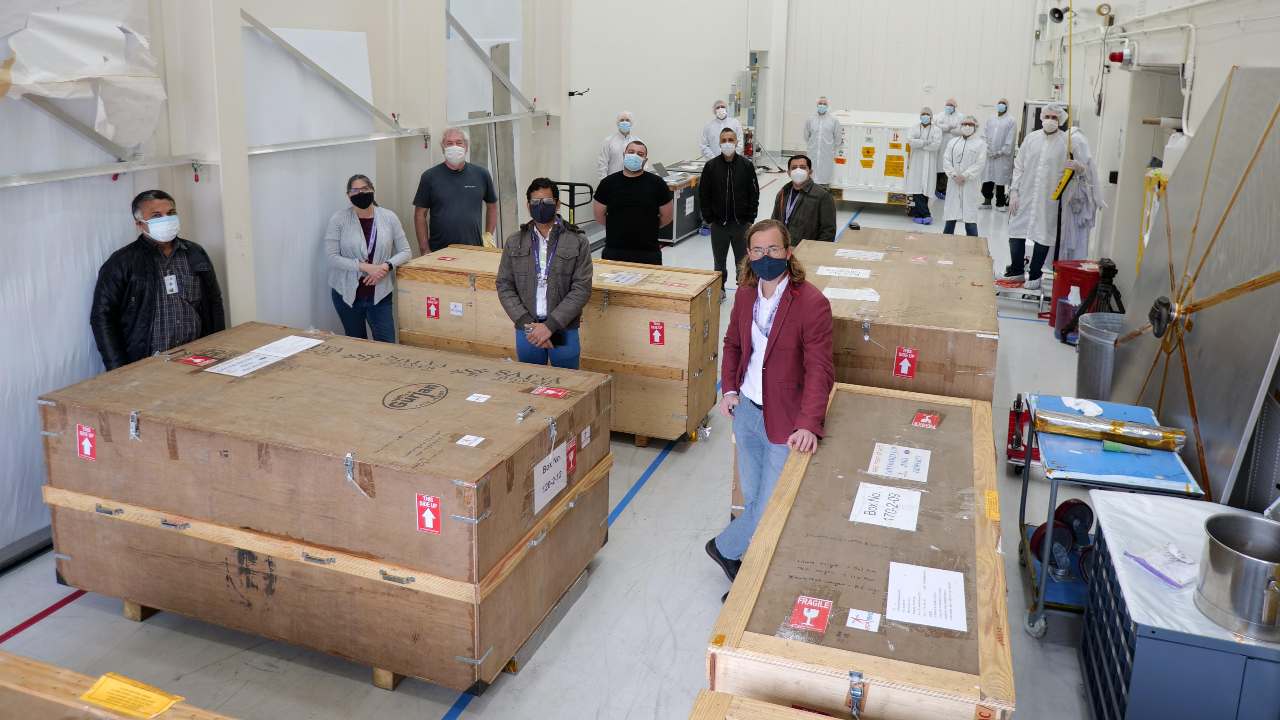
The S-band SAR, one of two types of radar for the NISAR mission, arrived at JPL on March 19. Credit: NASA / JPL-Caltech
The satellite will use two types of synthetic aperture radar (SAR) to measure changes in the Earth’s surface. The communication link to Earth includes a wire mesh radar reflector antenna that is 12 meters in diameter, perched on top of a nine-meter long (30 feet long) arm that pings and receives signals from radar to and from the Earth’s surface. This type of satellite communication is quite similar to weather radars, which use signals that bounce off raindrops to track storms.
The satellite images are supposed to be extremely detailed and will be able to show the smallest changes locally, but they will also be broad enough to measure regional changes. POT says NISAR will be able to detect movements on the planet’s surface as small as one centimeter in areas the size of half a tennis court. By collecting this data, you will help us understand the ’cause and consequence’ of all the changes that occur around the world. This will help us better manage our resources and adapt to changes as well.
Both radars can “see” through clouds and foliage, but the L band can penetrate deeper into dense vegetation than the S-band. According to a NASA statement, the image strip, the width of the strip of data collected along the trajectory of the orbit, is greater than 240 kilometers. This will allow the satellite to image the entire Earth in just 12 days.
NISAR is currently being assembled in a cleanroom at the US space agency’s JPL in Southern California. On March 19, ISRO shipped the S-band radar to the NISAR assembly, test, and launch team at JPL to be attached to the satellite. After assembly, the satellite will be sent back to India to prepare for launch, to be held at the UR Rao Space Center in Bangalore.

She is a freelance blogger, writer, and speaker, and writes for various entertainment magazines.