


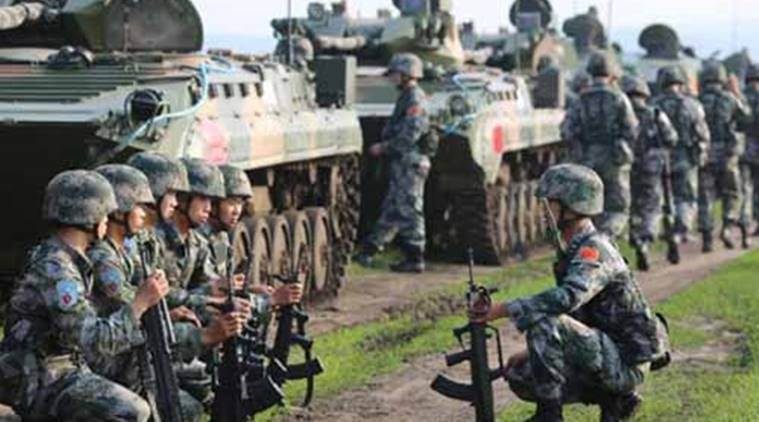
Shortly after coming to power in 2012, after the usual behind-the-scenes look, undercover power struggle secretary general Xi Jinping announced that China would begin restructuring the military. The reform process started in earnest in 2015. The big goal was to make the People’s Liberation Army (PLA) a world-class army (and world conqueror?) By 2025. The intermediate goals were to make it fully mechanized by 2020 and develop it in a fully computerized entity by 2035.
These reforms included the reform of the organizational configuration of the Central Military Commission, the creation of strategic entities that multiply the force such as the Strategic Support Force (SSF) and the Joint Logistics Support Force (JLSF) and the creation of theatrical commands to refine the joint. A key feature was that new effective weapon systems would be developed. The modernization and resulting improvements in firepower and combat readiness along with increased training accents have made PLA a more dynamic and aggressive force. This has been reflected in his renewed desire to enter into a showdown with India after the Doklam showdown in 2017.
The former Chengdu and Lanzhou Military Regions merged into a new all-encompassing Western Theater Command spanning Xinjiang, Tibet, and fully covering the borders of major neighbors India and Afghanistan. Its jurisdiction includes Sichuan, Tibet, Aksai Chin, Gansu, Ningxia, Qinghai, Xinjiang, and Chonqqing. It is of great importance that the Western Theater Command (WTC) covers the entire boundary with India from the northern end of the Siachen Glacier to the junction of India, China and Myanmar at Diphu Pass in Arunachal Pradesh. The implications of this should not be lost on us. It signals a new command structure that is being implemented to confront and pressure India and embark on another era of expansionism.
Under the new dispensation, an exception was made to the new rule governing formations under the command of the theater headquarters. The Tibet Military District, commanded by the eastern (Sikkim, Bhutan, and Arunachal Pradesh) and central (Uttarakhand, Uttar Pradesh, and Nepal) sectors on the India-China border, was upgraded to a higher level than other military districts. An obvious move to advance your operational potential and battle readiness. The other operating military district that is part of the theater is Xinjiang. His area of responsibility is the western part of the border between the two countries. Ladakh and possibly Himachal Pradesh are what this formation faces. In addition, both military districts are placed directly under the command of the PLA Ground Forces, unlike other military districts whose commanders report to the National Defense Mobilization Department of the Central Military Commission. These military districts are responsible for reserves, militia, and compulsory military service unlike Xinjiang and Tibet, which are the regional headquarters that control combat forces. They also manage logistics in their area of responsibility and have a special position of internal security, including the suppression of civil dissent.
The new Strategic Logistics Support Force has subordinate Joint Logistics Support Centers in each theater, with one in Xining for the WTC. China’s massive investment in road and rail infrastructure will allow it to deploy some 30 divisions from the interior of the country to the border in a span of around 40 days.
The PLA Land Forces exercise more command and control over the military districts of Tibet and Xinjiang due to their special status, compared to other positions under the authority of the CMC. This could lead to improper initiatives by commanders under the Group Armies without seeking the necessary political approval. Possibly this situation led to the attack on Indian soldiers in the Galwan Valley on June 15. Chinese forces in Tibet have relatively limited artillery capacity: currently, a single forward-deployed artillery regiment backed by an artillery brigade is deployed 200 km from the front line near Lhasa. They lack a significant fire support advantage in the early days of a conflict.
The Western Theater Command (WTC) has benefited greatly from China’s military modernization. The newly incorporated weapon systems are reportedly first deployed in Tibetan and Xinjiang MDs for testing and induction protocols. These logically include the third generation Type 15 light tanks, specially designed for mountainous terrain, extreme conditions, and difficult terrain. In addition, the laser-guided vehicle-mounted PCL-181 howitzers, the Z-20 medium-duty rotary-wing aircraft, and the GJ-2 attack UAVs.
KJ-500 Airborne Early Warning Aircraft (AEW) is now permanently deployed in Tibet MD. This could be a consequence of the Doklam 2017 clash. Although the latest PLAAF stealth plane J-20 has not been noticed in the skies over Tibet or Xinjiang, the last J-10, J-11, and J-16 (the last one is an indigenous variant of the Russian Su-27) deployed in the theater.
Similarly, Indian and American intelligence have been unaware of the presence of the Y-20 strategic lift transport or the Su-35 air superiority fighter. Chengdu J-20 air superiority fighters have been spotted on training missions on the Tibetan Plateau.
Changes made after Doklam include the upgrade of all four Tibet air bases and the commissioning of seven new heliports in border areas.
Training, maneuvers, and exercises involving all combat weapons, as well as joint service exercises, have received high priority at the WTC. High-altitude exercises, including night exercises, have been performed with inexhaustible regularity. This includes reinforcing the region with troops from other theaters and GHQ reserves. The excellent communications infrastructure, including railways, have been used to the end.
Theatrical missions include supporting the People’s Armed Police in maintaining internal stability in the restless regions of Tibet and Xinjiang. Disaster relief that requires liaison with civil organizations is also an important theatrical mission as with other theaters. External responsibilities include responding to possible unrest in Central Asia under the auspices of the Shanghai Cooperation Organization (OCS). The OCS-sponsored series of Peace Mission exercises since 2005 has trained OCS forces for combined operations responding to large-scale riots. However, the main strategic direction of the WTC is India and the disputed border regions. It is this core function that the WTC is most focused on and for which it trains and plans the most. It is time for us to take it more seriously.
As an example of the main focus of ETC and its application, let’s take the case of Combined Arms Tactical Training Bases (CATTBs) located in Xichang and Qingtongxia. These CATTBs are highly developed training facilities for combined arm and joint training with the PLAAF. Qingtongxia CATTB, established around the year 2000, includes an urban warfare training village, electromagnetic environment simulation, monitoring and control systems, as well as a 1: 500 scale model (900 meters x 700 meters) of the disputed border region from Aksai Chin. Nothing could give commanders at all levels a better idea of the battlefield and its topography.
The WTC trains primarily at the tactical level to organize joint border counterattack campaigns to defend against attack (assuming India takes the lead in launching an offensive) and to regain lost territory; mountain offensive campaigns; and joint campaigns of attack against a practicing enemy freely identified as India. A joint fire attack campaign is a long-range precision attack by missiles and airpower forces with the mission of destroying major enemy targets, paralyzing enemy operating systems, weakening the will to resist through terrorist attacks, and destroying the potential of war in the form of resources
At the end of the day, the WTC is there, heavily armed, and dangerous. We could start by countering it with a single theater command of our own.

She is a freelance blogger, writer, and speaker, and writes for various entertainment magazines.