


Myanmar Forces Escalate Crackdown on Protesters
In Yangon, the Myanmar police used rubber bullets to disperse a demonstration at the Myaynigone crossing, the site of an hours-long clash the day before.
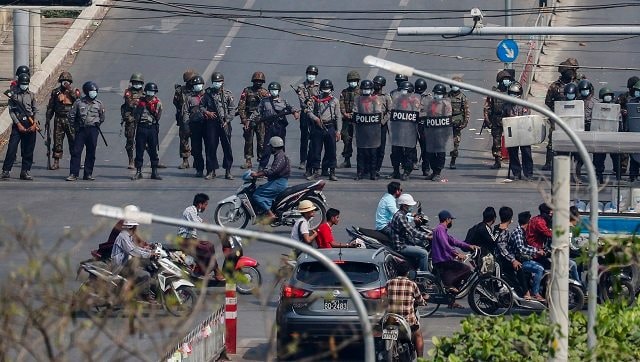
Police are in formation blocking the main road in Mandalay, Myanmar, on Saturday, February 27. AP
Yangon: Myanmar police fired rubber bullets to disperse protesters in Yangon on Saturday, a day after the country’s ambassador to the United Nations called for “the strongest possible action by the international community” to immediately restore democracy.
The country has been rocked by a wave of pro-democracy protests since a military coup toppled civilian leader Aung San Suu Kyi on February 1.
The authorities have gradually intensified the use of force to suppress dissent, using tear gas, water cannons, and rubber bullets to disperse some protests. Live rounds have been used in isolated cases.
In Myanmar’s largest city, Yangon, on Saturday, police used rubber bullets to disperse a demonstration at the Myaynigone crossing, the site of an hours-long clash the day before.
“What are the police doing? They are protecting a mad dictator,” the protesters chanted as they were chased away by the police.
Hundreds of Mon protesters had gathered there to mark National Mon Day, along with other ethnic minority groups to protest the coup.
They dispersed down smaller residential streets and began building makeshift barricades with barbed wire and tables to stop police. Many wore helmets and gas masks, wielding homemade shields to protect themselves.
At least 15 people were arrested, a police officer confirmed.
Local reporters broadcast the chaotic scenes live on Facebook, including the moments when the shots rang out, which AFP reporters on the ground also witnessed.
“We will try to find another way to protest, of course, we fear their repression,” said protester Moe Moe, 23, who used a pseudonym.
“We want to fight until we win.”
Among those arrested were three journalists: an Associated Press photographer, a videojournalist from Myanmar nowand a photographer from the Myanmar Pressphoto Agency.
‘This revolution must win’
The crackdown in Yangon came after Myanmar’s ambassador to the United Nations made an emotional appeal to the international community on Friday.
“We need the strongest possible action from the international community to immediately end the military coup, stop oppressing innocent people, return state power to the people, and restore democracy,” pleaded Kyaw Moe Tun.
Speaking briefly in Burmese, he pleaded with his “brothers and sisters” to continue fighting to end the military regime.
“This revolution must win,” he said, displaying at the end the three-finger salute that has become a symbol of resistance against the junta.
His call for democracy broke with the current rulers of Myanmar, something extremely rare for a UN representative, and was met with applause in the chamber.
The junta has repeatedly justified its seizure of power by alleging widespread electoral fraud in the November elections, which Suu Kyi’s party had overwhelmingly won, and promised new elections within a year.
The army chief, General Min Aung Hlaing, now has legislative, executive and judicial powers in Myanmar, effectively stopping the 10-year experiment with democracy in the country.
Suu Kyi, who has not been seen publicly since her arrest, now faces two charges for having unregistered walkie-talkies at her residence and breaking coronavirus rules.
While the Nobel laureate is expected to have a hearing on Monday, her lawyer has not yet been able to reach her.
More than 770 people have been arrested, charged and convicted since the February 1 coup, according to the watchdog group the Association for the Assistance to Political Prisoners, and about 680 remain behind bars.
But protests have continued apace in Myanmar, from the remote mountain ranges of the northern Chinese state to the southern coastal city of Dawei.

She is a freelance blogger, writer, and speaker, and writes for various entertainment magazines.