


The United States imposed sanctions on Myanmar’s interim president and several other military officials on Thursday, warning that their actions could result in more economic punishments as Washington reacts to the country’s military coup.
On Wednesday, US President Joe Biden issued an executive order preventing Myanmar generals from accessing $ 1 billion (€ 825 million) in assets in the US, adding that the specific targets of the sanctions would be identified later in the week. Now those targets have been identified.
The head of the army, General Min Aung Hlaing, who now holds the legislative, judicial and executive powers in Myanmar, has been subject to the embargo, along with the military leaders of the new cabinet, such as Defense Minister General Mya Tun Oo . Three gem exporting companies controlled by the Myanmar military have also been targeted.
Supporters call for more international action
However, supporters of the ousted leader Aung San Suu Kyi have called for tougher international action, saying the current sanctions are not enough.
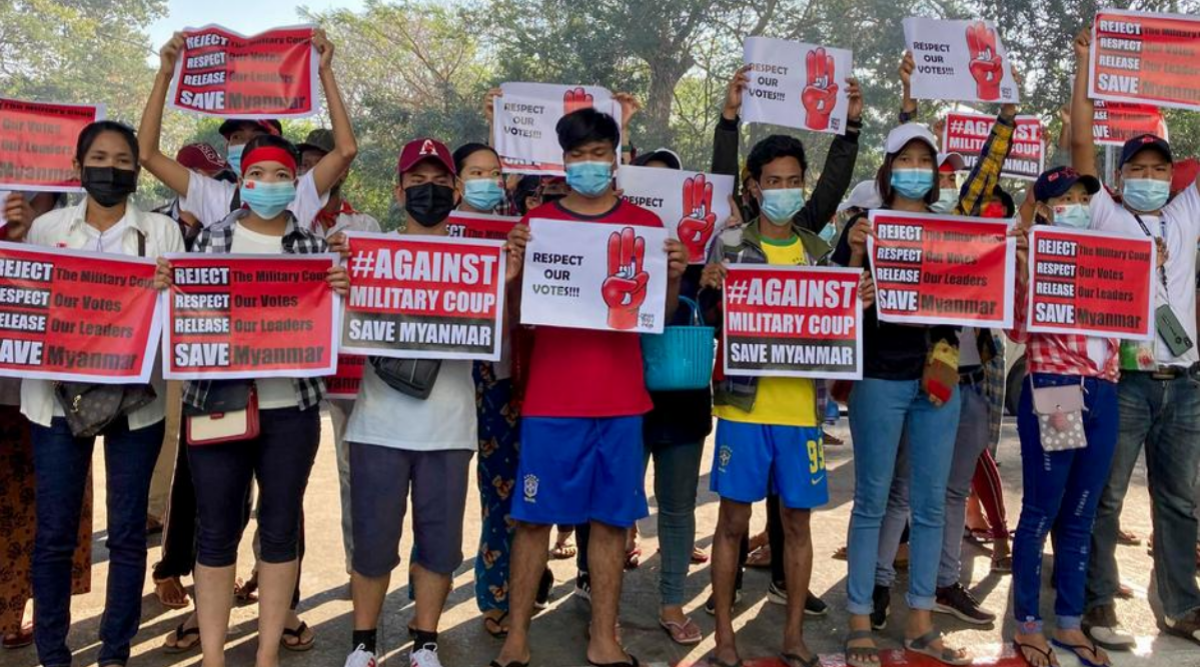
Supporters of Suu Kyi’s party, the National League for Democracy, have been holding demonstrations for six days. They welcomed the US sanctions, but felt they were insufficient.
“We expect more action than this as we are suffering from the military coup day and night here in Myanmar,” a supporter told the Reuters news agency.
Social media giant Facebook said it would reduce the distribution of content posted by Myanmar’s military junta. They said the related profiles “continued to spread misinformation” after the army took power on February 1.
The measures will seek to restrict the number of people who view the content and will apply to an official page run by the army and another by a spokesperson. Facebook said it had already suspended the Myanmar government’s ability to submit content removal requests.
‘The military must resign from power’
Myanmar has witnessed protests against the coup, condemning the removal of civilian leader Aung San Suu Kyi, for six consecutive days, and the unrest is expected to continue on Friday.
“We are also prepared to take further action if the Burmese military does not change course,” said Treasury Secretary Janet Yellen, using the former name Myanmar.
“If there is more violence against peaceful protesters, the Burmese army will find that today’s sanctions are only the first,” he said.
Biden had previously called on the military to release democratic political leaders and activists, adding that “the military must renounce power.”
Widespread disapproval of the coup
In Europe, the United Kingdom, which ruled Burma from 1824 to 1948, welcomed the punishment of the United States.
British Foreign Secretary Dominic Raab said on Twitter: “The international community will not accept the coup in Myanmar and we will hold those responsible to account. Britain is urgently considering new measures under our own sanctions regimes. “
The European Union’s foreign affairs chief, Josep Borrell, also warned that the bloc could implement new sanctions on the Myanmar military. Earlier this week, Borrell described the coup as “unacceptable.”
General warns protesters to return to work
Meanwhile, Myanmar’s Hlaing told officials on Thursday night that they must return to work after days of strikes across the country in support of the unrest.
“Due to the incitement of unscrupulous people, some of the public administration personnel have not fulfilled their duties,” he said in a statement. “Effective action will be taken.”
Since the coup there has been a torrent of anger and defiance, calling for the release of Nobel Peace Prize winner and deposed leader Suu Kyi, as well as other detained high-ranking figures from her National League for Democracy party.
On Thursday, protesters gathered once again in Myanmar to express their frustrations over the February 1 coup.
In the capital Naypyitaw, hundreds of people came to support the civil disobedience movement. They carried banners in support of the ousted leader Suu Kyi and chanted slogans against the junta. Despite previous clashes, the first marches on Thursday were peaceful.
The protesters also gathered in the cities of Dawei and Mandalay, as well as in the Yangon Mall, where they urged Myanmar’s central bank employees not to go to work.
.

She is a freelance blogger, writer, and speaker, and writes for various entertainment magazines.