


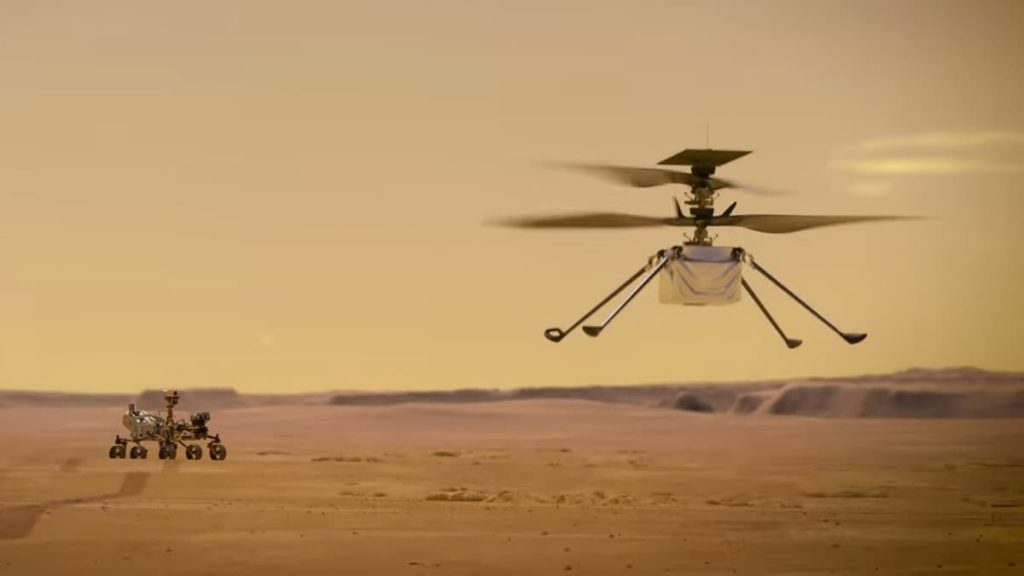
NASA Helicopter on Mars Ready for First Flight
The NASA helicopter on Mars could make its maiden flight over the Red Planet within two days after a successful initial test of its rotors, the US space agency said on Friday. The current plan for the first attempt at controlled and powered flight on another planet is for the four-pound (1.8 kg) helicopter, dubbed Ingenuity, to lift off from the Jezero crater of Mars on Sunday at 10:54 p.m. ET. (8:24 a.m. IST) and float 10 feet (3 meters) above the surface for half a minute, NASA said.
“The helicopter is fine, it looks healthy,” said Tim Canham, Ingenuity’s operations leader, at a news conference. “Last night, we did our 50 RPM turn, where we turned the blades very slowly and carefully,” he said.
The plan for Sunday is for it to soar, fly only vertically, float, and spin for 30 seconds to snap a photo of the Perseverance rover, which landed on Mars on February 18 with the helicopter attached to its underside.
Then the device will come back to the surface.
The flight will be autonomous, pre-programmed on the aircraft due to the 15 minutes it takes for signals to travel from Earth to Mars, and also due to the demanding environment of the distant planet.
“Mars is difficult not only when you land, but also when you are trying to take off and fly,” said MiMi Aung, Ingenuity project manager.
He explained that the planet has significantly less gravity than Earth, but less than one percent of the pressure of Earth’s atmosphere on the surface.
This makes it necessary for the Ingenuity to be able to turn its rotor blades much faster than a helicopter on Earth in order to fly.
“Put all of those things together and you have a vehicle that requires all entries to be correct,” Aung said. NASA captured the test of the rotors in a short video recorded from the rover just a few feet away, showing what looks like a small drone.
Aung said a second test would be conducted today, with the rotors running at high speed. “The only uncertainty remains the actual environment of Mars,” he said, mentioning possible winds.
NASA considers the unprecedented helicopter operation highly risky but says it could obtain invaluable data on conditions on Mars. NASA plans up to five flights, each successively more difficult, in a period of one month.

She is a freelance blogger, writer, and speaker, and writes for various entertainment magazines.