


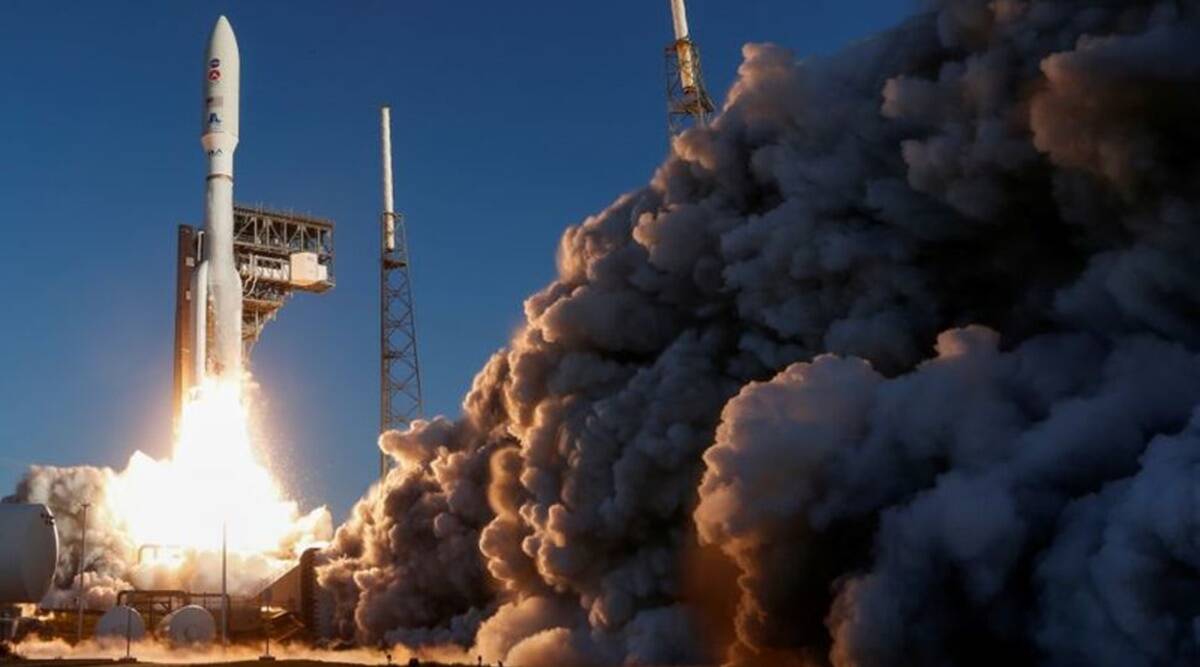
When NASA’s Perseverance rover, a robotic astrobiology laboratory inside a space capsule, reaches the final leg of its seven-month journey from Earth this week, it will emit a radio alert as it enters the thin Martian atmosphere.
By the time that signal reaches mission managers some 204 million kilometers away at the Jet Propulsion Laboratory (JPL) near Los Angeles, Perseverance will have already landed on the Red Planet, hopefully in one piece.
The six-wheeled rover is expected to take seven minutes to descend from the upper part of the Martian atmosphere to the planet’s surface in less time than the radio transmission of more than 11 minutes to Earth. So Thursday’s final self-guided descent of the rover spacecraft is scheduled to occur during a white-knuckle interval that JPL engineers affectionately refer to as the “seven minutes of terror.”
Al Chen, head of JPL’s descent and landing team, called it the most critical and dangerous part of the $ 2.7 billion mission.
“Success is never assured,” Chen said at a recent news conference. “And that’s especially true when we’re trying to land the largest, heaviest and most complicated rover we’ve ever built to the most dangerous place we’ve ever tried to land.”
Much depends on the outcome. Building on the discoveries of nearly 20 American sorties to Mars dating back to the Mariner 4 flyby in 1965, Perseverance can set the stage for scientists to conclusively demonstrate whether life has existed beyond Earth, while also paves the way for possible human missions to the fourth planet from the sun. . A safe landing, as always, comes first.
Success will depend on a complex sequence of events that run smoothly, from the inflation of a giant supersonic parachute to the deployment of a jet-powered “overhead crane” that will descend to a safe landing site and float above the surface while lower the vehicle. to the ground with a leash.
“Perseverance has to do all of this by itself,” Chen said. “We can’t help it during this period.”
If all goes according to plan, the NASA team would receive a follow-up radio signal shortly before 1 p.m. Pacific time, confirming that Perseverance landed on Martian soil at the edge of an ancient river delta and disappeared lakebed. long ago.
SURFACE SCIENCE
From there, the nuclear battery-powered rover, roughly the size of a small SUV, will embark on the main objective of its two-year mission: employing a complex array of instruments in search of signs of microbial life that may be present. flourished on Mars billions of years ago.
Advanced power tools will drill into Martian rock samples and seal them into cigar-sized tubes to eventually return to Earth for more detailed analysis, the first samples of its kind collected by humanity on the surface of another planet.
Two future missions to retrieve those samples and bring them back to Earth are in the planning stages by NASA, in collaboration with the European Space Agency.
Perseverance, the fifth and much more sophisticated rover that NASA has sent to Mars from Sojourner in 1997, also incorporates several pioneering features that are not directly related to astrobiology.
Among them is a small drone helicopter, dubbed Ingenuity, that will test propelled flight from surface to surface in another world for the first time. If successful, the four-pound (1.8 kg) whirlybird could pave the way for low-altitude aerial surveillance of Mars during subsequent missions.
Another experiment is a device to extract pure oxygen from carbon dioxide in the Martian atmosphere, a tool that could prove invaluable for the future support of human life on Mars and for producing rocket propellants to take astronauts home.
‘SPECTACULAR’ BUT TREATMENT
The mission’s first hurdle after a 472 million-kilometer flight from Earth is bringing the rover intact to the floor of Jerezo crater, a 45-kilometer-wide expanse that scientists believe. it can host a rich trove of fossilized microorganisms.
“It’s a spectacular landing site,” project scientist Ken Farley told reporters on a teleconference.
What makes the crater’s rugged terrain, deeply carved by long-vanished streams of liquid water, so tempting as a research site, also makes it treacherous as a landing zone.
The descent sequence, an update to NASA’s last rover mission in 2012, begins as Perseverance, encased in a protective shell, pierces the Martian atmosphere at 12,000 miles per hour (19,300 km per hour), nearly 16 times the speed of the sound on Earth.
After a parachute deployment to slow its fall, the descent pod’s heat shield is set to drop and drop a jet-propelled “overhead crane” hovercraft with the rover attached to its belly.
Once the parachute is dropped, the overhead crane’s jet thrusters are activated immediately, slowing its descent to walking speed as it approaches the crater floor and automatically navigates to a soft landing site, avoiding rocks, cliffs and sand dunes.
Hovering above the surface, the overhead crane is due to less perseverance on the nylon straps, cuts the ropes when the rover’s wheels reach the surface, and then flies to crash at a safe distance.
If all works, said the project’s deputy director, Matthew Wallace, the post-landing exuberance would be on the horizon at JPL despite COVID-19 security protocols that have kept close contacts within mission control to a minimum.
“I don’t think COVID is going to be able to stop us jumping up and down and hitting our fists,” Wallace said.
.

She is a freelance blogger, writer, and speaker, and writes for various entertainment magazines.