


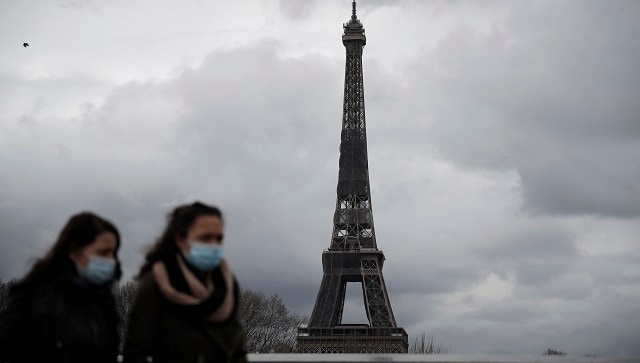
Paris to enter month-long COVID-19 lockdown
Prime Minister Jean Castex said the measures were due to a higher number of cases, with around 1,200 people in intensive care in the Paris region alone.
The French government is preparing to announce new coronavirus restrictions that could include a blockade of the Paris region and northern France as the number of COVID-19 patients in intensive care units increases. AP
Paris: French Prime Minister Jean Castex announced on Thursday a limited one-month shutdown for Paris and several other regions to combat the surge. COVID-19 cases, although he insisted that the measures would be less stringent than in the past.
While nonessential businesses will close and outward movement will be restricted in affected regions, schools will remain open and outdoor exercise will be allowed up to 6 miles from home, he said.
President Emmanuel Macron had so far resisted imposing a nationwide lockdown this year, but his prime minister said the situation in Paris and elsewhere caused regional measures that affected around a third of the country’s population. were unavoidable.
“We are adopting a third way, a way that should make it possible to stop (the epidemic) without locking up (people),” Castex told reporters.
He said the measures were due to a greater number of COVID-19 cases due to a “third wave” of the virus, with around 1,200 people in intensive care in the Paris region alone.
The other regions affected by the new measures also include, in particular, the Hauts-de-France region in north-eastern France, which covers the city of Lille, as well as the Alpes-Maritimes in the Mediterranean, as well as Seine-Maritime and Eure in the north. .
Health Minister Olivier Veran said there were more people in intensive care in the Paris region than during the second wave in November, with hospital capacity now saturated.
But with a note of hope, he added: “We really hope that with these braking measures we will pass the peak of this wave and on the other side of this wave we will find spring and, unlike last year, the protection of the population through vaccination. ”
As in previous blockades, a written or downloaded form will be needed on the phone to justify why a person has left home in areas under the new restrictions.
Residents in the affected regions will not be able to travel to other areas except for essential businesses, Castex said.
But Castex said that “while this is not good news” for people living in those regions, the restrictions were less severe this time.
“These containment measures will not be a repeat of the ones we imposed last March and November,” Castex said.
Meanwhile, the curfew that has been in place across the country will also be relaxed across France, ending at 7 p.m. instead of 6 p.m. to account for longer days, Castex said.
Distinguishes us
Almost exactly a year ago, Macron ordered France’s first national blockade, which was one of the strictest in the world, followed by a second in late October.
The handling of the health crisis has consequences for Macron, just over 12 months before the presidential elections, in which he is expected to seek a second term.
The president wanted to emphasize that the limitations in France have been limited this year compared to the blockades observed in Great Britain and Germany.
Defending the president, Castex said that if France had decided to shut down in January “then we would have inflicted a lockdown on the country of probably three months,” adding that keeping schools open was “a choice that sets us apart from many of our neighbors.”.
‘Confidence will return’
But the government is well aware that in addition to seeing a skyrocketing rise in cases, France has gotten off to a slow start to its vaccination campaign with just 5.6 million people receiving the first dose.
This week it suspended the use of the AstraZeneca / Oxford jab in line with many European countries after reports of blood clots.
But following the green light from the European Medicines Agency (EMA) that the vaccine was “safe and effective,” the jabs will now resume, Castex said, adding that he would receive the AstraZeneca jab himself on Friday.
“I will get vaccinated with this vaccine to show that we can have complete confidence in it,” Castex said. “I am convinced that confidence will return.”
The French Minister for Europe, Clement Beaune, defended the choice of many European countries to suspend the use of the vaccine and refer it to the EMA for safety checks.

She is a freelance blogger, writer, and speaker, and writes for various entertainment magazines.