


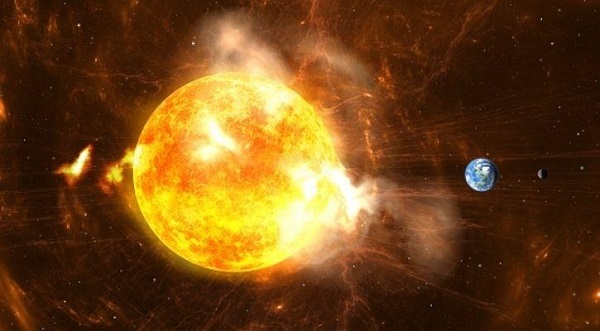
At least 17 solar outbursts from a single sunspot have shot into space recently, and moderate geomagnetic storms might reach Earth by Thursday.
The flares were caused by a hyperactive sunspot named AR2975, erupting on Monday. According to Space.com, the stellar explosion may also trigger some moderate sky storms.
What Exactly are Sunspots?
Sunspots are solar eruptions when magnetic lines twist and realign abruptly near the visible surface. Coronal mass ejections (CMEs), or streams of charged particles that launch into space, are sometimes connected with these explosions.
The Solar and Heliospheric Observatory and NASA’s powerful Solar Dynamics Observatory obtained breathtaking photos of the solar explosions.
Solar storms possible to hit Earth today
“At least two, probably three CMEs have been blasted toward Earth,” said SpaceWeather.com of the event.
According to the report according to NASA and the National Oceanic and Atmospheric Administration, the first CME is predicted on Thursday (March 31), with at least one more on Friday (April 1).
NASA and other space agencies monitor solar activity.
Although auroras (northern and southern lights) are notoriously difficult to predict, modeling predicts that the particles could cause G2 or G3 (moderate) geomagnetic storms. While this potential storm is relatively mild, NASA and other space organizations monitor solar activity to improve solar weather forecasts.
A strong flare aiming toward Earth, combined with a massive CME, might cause power line damage or disabling satellite problems.
Overall, the Sun is predicted to be pretty calm in 2022, as we are still near the 11-year solar cycle, which began in December 2019.
There are frequently fewer sunspots and eruptions at the start of a cycle. However, as we get closer to the peak, expected in mid-2025, the activity could pick up.
According to the BBC, scientists discuss how strong this current solar cycle will be, with estimates indicating that the average number of sunspots may be lower than typical.

Eric is a professional news editor, writer, and blogger for the last 10 years. He is working with NewsGater as an off-beat news editor cum writer.