


U.S. Urgees Turkey to Transfer Russian-made Missile Defence System to Ukraine.
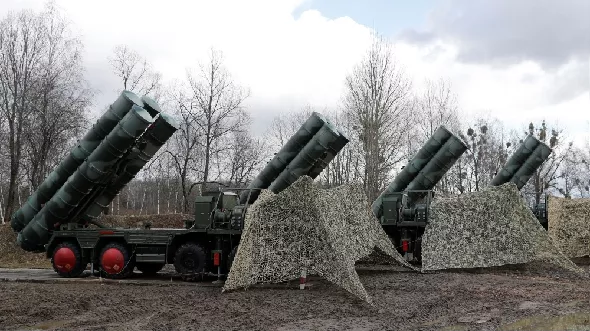
WASHINGTON: According to three sources acquainted with the situation, the U.S. has broached the unlikely option of delivering its Russian-made S-400 missile defense systems to Ukraine to assist it in fighting invading Russian forces.
According to Reuters, U.S. officials have floated the idea with their Turkish counterparts over the past month, but no explicit or formal request has been made.
It was also mentioned briefly during Deputy Secretary of State Wendy Sherman’s visit to Turkey earlier this month, according to the sources.
As Ukraine seeks to fend off a Russian invasion that began on February 24, the Biden administration has asked friends that have been using Russian-made equipment and systems, like S-300s and S-400s, to consider transferring them to Ukraine.
MORE: Russia Uses Hypersonic Missiles First Time in Ukraine-Romania Border.
The proposal, which observers predicted would be rejected by Turkey, was part of a larger conversation between Sherman and Turkish officials on how the U.S. and its allies should do more to support Ukraine and strengthen bilateral ties.
The Turkish government has not responded to any U.S. suggestion or proposal on the transfer of Ankara’s S-400 missile defense systems to Ukraine, which has been a point of disagreement between the two NATO members for years.
Officials from Turkey’s foreign ministry could not be reached for comment right away.
Any such proposal, according to Turkish sources and analysts, would be a non-starter for Turkey, citing issues ranging from technical difficulties in deploying and operating the S-400s in Ukraine to political concerns about the fallout Ankara would certainly receive from Moscow.
Since the initial delivery in July 2019, Washington has requested Ankara to get rid of the Russian-built surface-to-air missile batteries. As a result, the U.S. has put penalties on Turkey’s defense industry, and NATO member Turkey has been withdrawn from the F-35 fighter jet program.
Ankara claims it was compelled to choose the S-400s because partners refused to offer weaponry on acceptable terms.
Officials in the United States are eager to exploit this opportunity to reintegrate Turkey into Washington’s orbit.
Efforts to identify “innovative” methods to mend the tense relationship have escalated in recent weeks, according to U.S. and Turkish sources, despite the fact that no concrete idea has yet gained support.
“I think everyone recognizes that the S-400 has been a long-standing issue, and perhaps now is the time to find out a new method to tackle this problem,” Sherman said in an interview with Turkish TV Haberturk on March 5.
It was unclear what she was referring to, and the State Department has yet to respond to concerns regarding her remarks.
A request for comment from the White House about the suggestion made during her visit to Turkey was not returned.
The operation is also part of the Biden administration’s larger attempt to react to Ukrainian President Volodymyr Zelenskiy’s request for assistance in protecting Ukraine’s airspace.
Air defense systems built by Russia or the Soviet Union, such as the S-300s and S-400s used by other NATO partners, are in high demand.
According to a person familiar with U.S. thinking, the prospect was floated as part of a renewed push to restore ties at a time when Ankara was shaken by Russia’s invasion of Ukraine.
Another person acquainted with the negotiations claimed Turkish President Erdogan had not received a particular warning from Russian President Vladimir Putin about his plans for a full-scale strike on Ukraine.
In the Black Sea, Turkey shares a maritime border with both Ukraine and Russia, with which it has strong ties. It has condemned the invasion and shown sympathy for Ukraine, but it has also rejected sanctions on Russia while trying to negotiate.
Analysts say Ankara has carefully crafted its speech so as not to alienate Moscow, with whom it has close energy, defense, and tourism connections.
Ankara, on the other hand, has sold military drones to Ukraine and signed a pact to co-produce more, which has enraged the Kremlin.
Turkey opposes Russian policy in Syria and Libya, as well as the annexation of Crimea by Russia in 2014.
“Turkey has managed to walk on a knife’s edge, and a transfer of a Russian S-400 would undoubtedly enrage Russia,” said Aaron Stein, director of research at the Foreign Policy Research Institute in Philadelphia.
“The S-400 has become a symbol of Turkish sovereignty for Erdogan, so selling it would not be all roses and flowers.”

Eric is a professional news editor, writer, and blogger for the last 10 years. He is working with NewsGater as an off-beat news editor cum writer.