


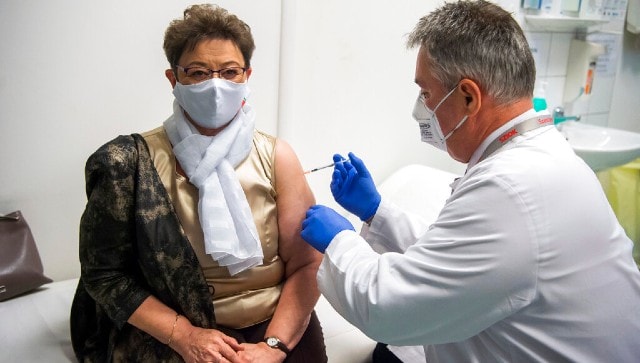
US Agencies Recommend Pause on use of J&J Vaccine Due to Blood clots
Most cases of blood clotting occurred within the first 14 days after vaccination, mainly in women under 60 years of age. AP
Federal health agencies will call for an immediate pause in the use of Johnson & Johnson’s single dose on Tuesday. coronavirus vaccine after six recipients in the United States developed a rare disorder involving blood clots within two weeks of vaccination, officials briefed on the decision said. The six beneficiaries were women between the ages of 18 and 48. A woman died and a second woman in Nebraska was hospitalized in critical condition, authorities said. Nearly 7 million people in the United States have received injections from Johnson & Johnson so far, and about 9 million more doses have been shipped to the states, according to data from the Centers for Disease Control and Prevention.
While the measure is framed as a recommendation for healthcare professionals in the states, the federal government is expected to stop administering the vaccine at all federally administered vaccination sites. Federal officials are hoping state health officials will take it as a strong signal to do the same.
Scientists from the Food and Drug Administration and the CDC will jointly examine the possible links between the vaccine and the disorder and determine whether the FDA should continue to authorize the use of the vaccine for all adults or limit the authorization. An emergency meeting of the CDC’s external advisory committee was scheduled for Wednesday, authorities said.
An FDA spokeswoman declined to comment.
The move could substantially complicate the nation’s vaccination efforts at a time when many states are facing a surge in new cases and seeking to address concerns about vaccines. Regulators in Europe and elsewhere are concerned about a similar problem with another coronavirus vaccine, developed by researchers at AstraZeneca and the University of Oxford. That concern has led to some resistance to all vaccines, even though the AstraZeneca version has not been approved for use in the United States.
Most of the nation’s vaccine supply comes from two other manufacturers, Pfizer-BioNTech and Moderna, which together deliver more than 23 million doses a week of their two-shot vaccines. There have been no significant safety concerns about any of those vaccines.
But while Johnson & Johnson vaccine shipments have been much more limited, the Biden administration still counted on the use of hundreds of thousands of doses each week. In addition to requiring a single dose, the vaccine is easier to ship and store than the other two, which must be stored at extremely low temperatures.
It is unclear to what extent the pause in Johnson & Johnson vaccine use will delay the Biden administration’s plans to deliver enough vaccine to be able to inoculate all adults in the United States by the end of May.

A woman is vaccinated against the COVID-19 vaccine in New Delhi. Image Credit: AP Photo / Altaf Qadri
In the United States alone, between 3,00,000 and 6,00,000 people a year develop blood clots, according to CDC data. But the particular blood clotting disorder that vaccine recipients developed, known as cerebral venous thrombosis, is extremely rare. All of the women developed the condition between six and 16 days after vaccination, and government experts are concerned that the cause is an immune system response triggered by the vaccine.
The decision is a further blow to both Johnson & Johnson and the administration’s plans. Late last month, the company discovered that workers at a Baltimore plant run by its subcontractor had accidentally contaminated a batch of vaccines, forcing the company to discard the equivalent of 13 to 15 million doses. That plant was supposed to take oversupply of the vaccine to the United States from Johnson & Johnson’s Dutch plants, which were certified by federal regulators earlier this year.
FDA certification of the Baltimore plant has now been delayed while inspectors investigate quality control issues, dramatically reducing the supply of the Johnson & Johnson vaccine. The sudden drop in available doses prompted widespread complaints from governors and state health officials who expected much larger shipments of the Johnson & Johnson vaccine this week than they received.
States have been using the vaccine in a wide range of settings, including mass vaccination sites and on campus. The authorities have also directed it to transitory, rural, and isolated communities where follow-up with a second dose is more complicated.
It is common for regulators to investigate so-called “safety signals” in new vaccines and other medical products. Very often, the signs are not a cause for concern. But concerns about Johnson & Johnson’s vaccine mirror concerns about AstraZeneca’s, which European regulators began investigating last month after some recipients developed blood clots.
Of the 34 million people who received the vaccine in Britain, the European Union and three other countries, 222 experienced blood clots related to low platelets. Most of these cases occurred within the first 14 days after vaccination, mainly in women under 60 years of age.
On April 7, the European Medicines Agency, the main regulatory agency, concluded that the disorder was a very rare side effect of the vaccine. Researchers from Germany and Norway published studies on April 9 that suggested that, in very rare cases, the AstraZeneca vaccine caused people to produce antibodies that activated their own platelets.

She is a freelance blogger, writer, and speaker, and writes for various entertainment magazines.