


Why Denmark is clamping down on non-Western residents
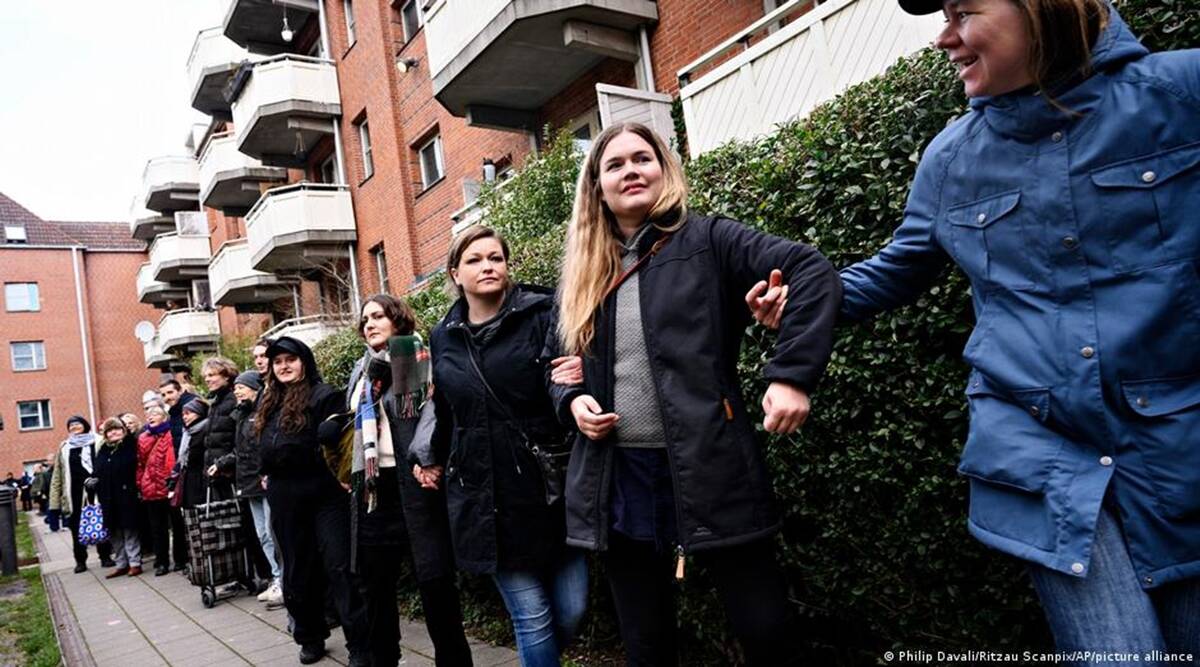
Human rights groups have sounded the alarm about the Danish government’s plans to change its controversial “ghetto” laws that affect marginalized neighborhoods to stricter measures targeting “non-Western” residents.
Last week, the Interior Ministry unveiled proposed reforms that would eliminate the word “ghetto” in current legislation and reduce the proportion of people of “non-Western” origin in social housing to 30% in 10 years. Families expelled from these areas would be relocated to other parts of the country.
A vote on the bill has not yet been set, but it is expected to pass. If passed in its current form, the measures will meet immediate resistance from human rights defenders.
‘Red flags’ on human rights
Nanna Margrethe Kusaa, Senior Legal Adviser at the Danish Institute for Human Rights, tells DW: “Our concern is that ethnicity criteria are sharper in focus than before.”
“We are very concerned about this issue and we follow it closely because it generates red flags every time ethnicity is included as a criterion,” he adds.
Under the current “No Ghettos” law, which was passed in 2018, the proportion of “non-Westerners” is capped at 50% in neighborhoods with more than 1,000 people whose residents meet two out of four criteria for unemployment rates, crime, education. and income.
The UN Office of the High Commissioner for Human Rights warned last year: “The effect is that ‘non-Western’ disproportionately means the non-white and non-European ethnic populations of Denmark.”
Kusaa tells DW that there are three pending court cases in Denmark about the impact of current “ghetto” legislation, lawsuits involving the Danish Institute for Human Rights.
“In our opinion, there is a strong risk of discrimination in these cases, which we believe is related to the criteria of the ‘ghetto’”, says Kusaa, which could violate national and EU laws. The lawsuits in Denmark continue.
What is ‘non-Western’ and why is it targeted?
The Ministry of the Interior and Housing notes that its “non-Western” rating is in line with Statistics Denmark, the country’s central statistical authority.
Western countries under this concept include the EU states, as well as the United Kingdom, Andorra, Iceland, Liechtenstein, Monaco, Norway, San Marino, Switzerland, the Vatican State, Canada, the United States, Australia, and New Zealand.
“All other countries are non-Western countries,” the ministry said in a statement to DW on Tuesday.
“The distinction between Western and non-Western countries has nothing to do with the political system, religion, economy or culture of a country,” he added.
The new proposal aims to take on what it calls “parallel societies,” a term the government uses to label areas that it believes lack integration into Danish society. The Interior and Housing Ministry said that when considering the unemployment rate, education and crime rates, the number of “non-Western residents is an indicator of integration problems.”
‘Hit Muslims and Immigrants’
But critics argue that such proposals will only further stigmatize Danes of diverse backgrounds, especially people of color and Muslims. Ozlem Cekic, a former lawmaker who was one of the first women with Muslim immigrant backgrounds elected to the Danish Parliament, says current “ghetto” legislation and the latest proposals are counterproductive.
“I agree with the government that there are some very big problems in some communities. I accept that. But the difference is that the problem here is not so big that we have to get people out of their homes, “he told DW, referring to the low rate of” non-Western “residents in troubled areas.
According to the University of Copenhagen, citing 2020 statistics from Denmark Statistics, only 5.3% of migrants from “non-Western countries” live in so-called ghetto areas.
For Cekic, who is also Kurdish, the legislation targets the marginalized. “It is not only created to hit Muslim groups and immigrant groups, but also the working class. Many people who live in the ‘ghettos’ do not have economic stability. ”
Political gains or setbacks?
Denmark has some of the strictest European policies on immigration and integration. Unlike many other countries, in recent years the main political parties on the right and left have adopted stricter control over immigration and asylum.
When the center-left Social Democrats were defeated in the 2015 elections, Mette Frederiksen took over the leadership of the party, which decided that it “clearly needed to take a tough stance on all things immigration,” says Rune Stubager, professor of immigration. Political Sciences. at Aarhus University. “And they did so, quite visibly and vocally since 2015. Now they are fighting tooth and nail to stay in this line.”
The recent government measures, even if controversial, are likely to benefit the party, regardless of how Danish courts settle the “non-Western” quotas. “In fact, it may be worth it even if they lose that case (to discrimination) because they would have shown their voters, and the voters they want to attract, that they are doing their best,” says Stubager.
But Ozlem Cekic says current government legislation and the new proposal will only backfire in the long run.
“I talk to children who live in this area and they think they are Danish because they were born in Denmark, they have Danish passports, they speak Danish, they go to schools here, but people always tell them, ‘You are not Danish because you are Muslim.’
“How can they be expected to be loyal to the country that does not accept them as they are?” she says. “I fear what kind of citizen the next generation will be when they grow up and how policies will affect them.”

She is a freelance blogger, writer, and speaker, and writes for various entertainment magazines.